12 DOES YOUR CHILD NEED TO CHELATE TOO?
Susceptibility to mercury is often due to genetic factors. If you have chronic mercury poisoning, the rest of your family is at risk, too. It is also possible that you were somehow exposed at home. In this case your children are at risk since children are more sensitive than adults. You will need to evaluate your children to decide if they need chelation. Fortunately, children are much easier to chelate than adults.
People often find it confusing to figure out if a child needs to be chelated. As long as the child doesn’t have amalgam fillings, the simplest thing is to just give it a try. You will only need a few weeks to find out if they are going to respond. It isn’t very expensive, nor does it involve invasive and scary blood tests. A hair test is often informative and that just involves cutting some hair. (Information about hair tests is in section 4.2.) More information can be found in Hair Test Interpretation: Finding Hidden Toxicities along with case reports on many toxic children. If mercury is causing a problem your child will get better with chelation. If it’s not mercury, nothing will happen. You have nothing to lose but a future of suffering and grief that neither you nor your child need to experience.
If something suspicious is going on with your child, it is worth a trial of chelation. By “suspicious” we mean: being late on developmental milestones, having certain developmental or health problems, having dietary issues or being different from other children in some specific ways. All of these are spelled out below.
Childrens growth and development are very well regulated, reproducible processes. Each normal, healthy child develops and grows just about the same way as all the others. That’s why the CDC can provide checklists that chart which behaviors will begin at what ages.
Children will not complain of even severe disability until at the earliest 5th or 6th grade. They assume that everyone is just like them. Doctors wait for the parents to complain, then make the diagnosis by asking the parents questions about the child. A mild disability like ADHD won’t be detected until adulthood unless you, the parent, figure out what is going on.
We have developed some charts from a variety of sources and put them in a form that is easy for you to use. If your child is not following these charts, or if he or she is not developing like the neighbor’s kids, or like grandma remembers you developing, something is wrong. Too much mercury is usually the problem. Normal development will resume as soon as you get the mercury out.
The charts show deadlines. Your child should do each thing listed on the chart before the age given. If it hasn’t happened by then, something is wrong and you need to follow up. If a lot of the milestones are late, or haven’t happened at all, it’s a big problem, and usually a mercury problem. If it’s not mercury, it could be lead, antimony or arsenic, but all of these are chelatable.
If you have a baby book or a diary, refer to that to get dates for milestones. If not, go over your photos, videos and emails. If you know your child has missed many milestones, stopped progressing or regressed, it is definitely time to chelate.
Following the charts is a discussion of other issues that may come up if your child has too much mercury and needs to chelate. There is no schedule for these issues as they can come up at any time.
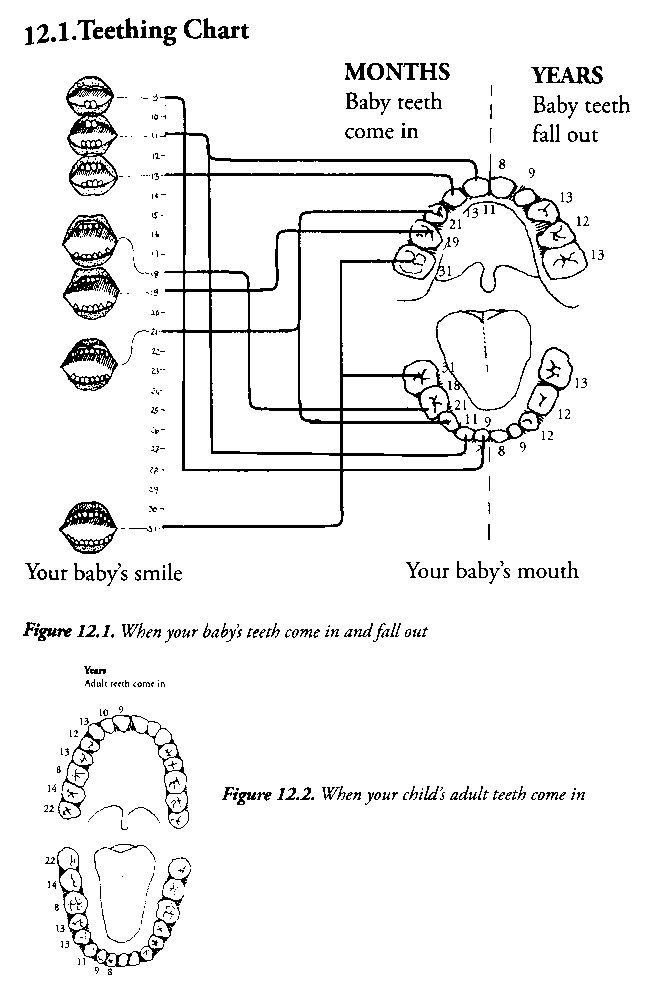
The figures above is a timeline for when children’s teeth should come in and fall out. Figure 12.1 shows what your baby’s teeth should look like as he grows. The left side of the figure shows when each baby tooth should come in (in months); the right side shows when each baby tooth should fall out (in years). Figure 12.2 shows when the adult teeth should come in (in years).
If your baby’s teeth come in or fall out earlier than the time shown on these charts, that is just fine. If your baby has more teeth in his mouth than shown in Figure 12.1, that is okay, too, The teeth may also show up in a slightly different order. The problem arises if some teeth do not come in by the correct age. That’s not normal and you need to find out what is wrong. If anybody tells you, “It’s normal, it’s nothing to worry about, some kids are just like this,” they’re wrong.
One thing to look into if your child’s teeth are not coming in on time is low thyroid hormones. Low thyroid hormone levels need to be corrected early. Low thyroid can cause delayed teething as well as failure to thrive (delayed growth, walking and talking). It can also cause a permanent IQ reduction and lifelong bad teeth. Mercury and lead both impair thyroid function.
Another warning sign of low thyroid levels is a child who is contented, sleeps through the night, is not fussy and seems like a “good baby” before the age of four months.
12.2 Timeline of developmental milestones
This timeline shows a large number of things children start to do as they develop. Every sentence is one milestone. The times are the age by which your child should already have done this. If it isn’t happening by the stated age, something is wrong. If several milestones are missed, it’s usually mercury. If it’s not mercury, it is usually some other toxic metal.
If your child was a premature baby, you need to calculate a corrected age to use with these timelines. These charts are for a child born at 40 weeks of gestation.
Table 12.1
Timeline of developmental milestones
Age
WHAT YOUR CHILD SHOULD ALREADY BE DOING
2 months
• smiles back at you
4 months
• should NOT be sleeping through the night until now
• enjoys eye contact
5 months
• smiles spontaneously
6 months
• smiles and shares enjoyment
7 months
• sleep-wake schedule has become predictable
8 months
• sits without support
• turns towards a voice
• smiles often
10 months
• says “mama and “dada” but often not to the right person
• becomes shy of strangers
• clings to mother
12 months
• stands with assistance
• babbles and points
• responds to name
• looks you in the eye
• knows a word beyond “mama” and “dada”
14 months
• crawls on hands and knees •walks with assistance
• stands on his own
• uses “mama” and “dada” for the correct person
16 months
• stacks 2 blocks
• uses single words
17 months
• drinks from a cup
18 months
• walks on his own
• points to things to communicate
• imitates others
• plays by pretending to do everyday things the parents do like talk on the phone, open the door, do dishes
Table 12.1
Timeline of developmental milestones
Age
WHAT YOUR CHILD SHOULD ALREADY BE DOING
20 months
• runs
22 months
• stacks 6 blocks
• can take off clothes you unbutton
24 months
• knows what a brush, fork, spoon and phone are for (but cant use them)
• knows 50 words
• talks using 2 word phrases
• points to an object or body part you name
• a stranger can understand half his words
• can walk up stairs slowly and deliberately
• looks when you point at things
• pretend play extends to things like feeding a doll
30 months
• can pedal a tricycle
• can use a spoon
• can verbally identify a picture when you show it to him
36 months
• can walk up stairs one tread per pace
• can use a fork
• can follow 2 step commands •speaks in 3-4 word sentences, of which
a stranger will understand 3 words in 4
39 months
• uses plurals
42 months
• can put on pants, but not do snaps or zippers
• does not stutter
45 months
• gives first and last name
Table 12.1
Timeline of developmental milestones
Age
WHAT YOUR CHILD SHOULD ALREADY BE DOING
4 years
• puts on a shirt or blouse but can’t do the buttons
• can hop
• interacts with people other than family
• engages in imaginary play
• can describe his emotions and what are causing them
• makes jokes, teases, engages in word play
• uses “me” and “you” properly
• can recite a favorite story
• can use sentences more complex than subject/verb/objects
4 years 2 months
• can hold a pencil adult-style
4 years 4 months
• can catch a ball
4 years 6 months
• washes and dries hands well
4 years 10 months
• can skip
5 years
• has friends outside the family •plays boy’s games for boys and girl’s
games for girls
• knows difference between real and make believe
• tells stories that have a plot
• uses the future tense
• can pay attention to 1 task for 5 minutes
• a stranger can understand every word
• can dress without help
• can do a sit-up
6 years
• plays with same age (or older) children
• can focus on one task for 15 minutes
• responds appropriately in conversation and takes speaking, using sentences of 5-7 words
9 years
• can pay attention to one task for 1 hour
12.3 Growth charts
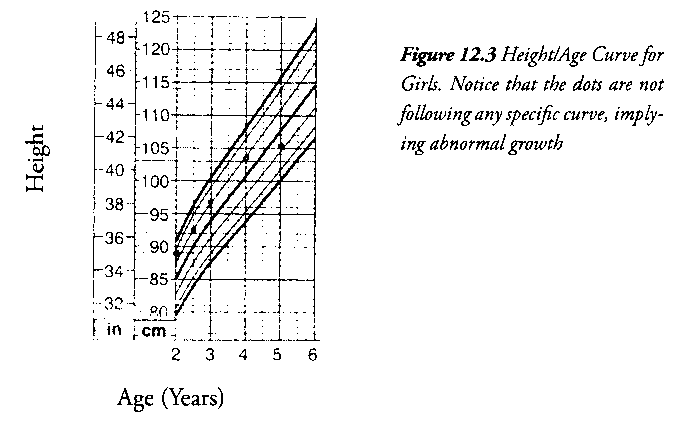
Children grow in a very reproducible manner. That’s why there are growth charts! When you go to those “well baby” visits, your doctor is supposed to be filling them in, although almost none of them bother. However you can get those charts and use them. The World Health Organization charts are best for breast fed babies, the Centers for Disease Control charts are best for formula fed babies
3 . A normally growing child will follow along parallel to the growth percentile lines. If they’re average, tall, or short, they stay that way all along unless something is wrong.
The plotted line on these growth charts
4 show children with developmental problems. Once you see that your line doesn’t match up with one of the lines on the chart, figure out what is wrong! Even pediatricians who keep these charts seldom bother to do anything when a problem shows up. This usually leads to the problem becoming far more severe than it would have been if timely action had been taken
Age (Years)
Figure 12.3
Height!Age Curve for Girls. Notice that the dots are not following any specific curve, implying abnormal growth
Girls Weight-for-age percentiles
Birth 3 6 9 12 15 18 21 2
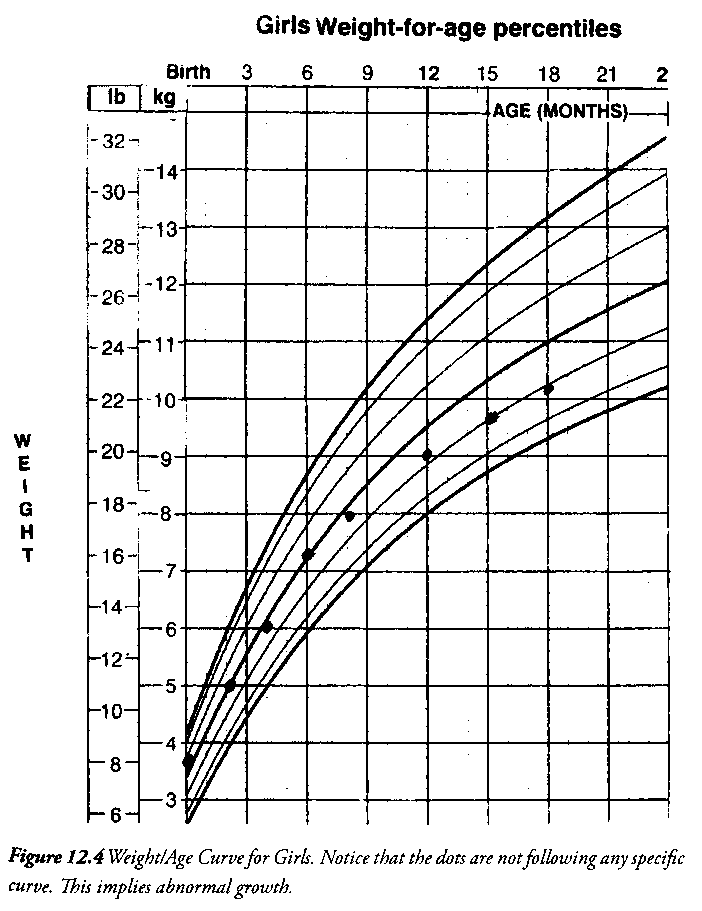
Figure 12A
Weight!Age Curve for Girls. Notice that the dots are not following any specific curve. This implies abnormal growth.
12.4 Medical diagnoses
There are a number of diagnoses that go along with mercury and lead poisoning in children. If your child has any of these you probably need to chelate him.
• autism spectrum disorders, ADHD or social communication disorder
• epilepsy, mood instability (e. g. bipolar disorder), schizophrenia, obsessive-compulsive disorder, depression, anorexia, bulimia, anxiety
• dyslexia, sensory integration disorder, convergence insufficiency, accommodative insufficiency, strabismus, amblyopia (lazy eye)
• need for vision therapy, as diagnosed by an eye doctor
• asthma, terrible allergies, dangerous food allergies
• hypothyroidism
12.5 Food and diet
Mercury affects peoples reactions to food. Some signs that you need to chelate your child are:
• his cheeks turn red after dinner and their behavior changes
• he self-limits his diet
• his behavior changes after eating colored prepared foods like red or green gelatin, Mountain Dew soda, pickles or canned orange juice concentrate
• he is gluten intolerant or has celiac disease
• he craves and only wants to eat sweets and starches
• he is gassy and bloated after meals
• he has frequent stomach pains or digestive problems
• he needs to be on some kind of special diet
12.6 Common sense
The genes that control your child’s development are the same that controlled his ancestors’ development. His ancestors nursed, played, learned, grew and matured in a consistent pattern from the Stone Age through ancient and biblical times, through the Middle Ages, the Renaissance, the Industrial Revolution, the last century right up till now. Normal healthy development has been crucial to the survival of our species for thousands of years and its clear almost all children will develop normally if nothing interferes. If a child is not developing normally, it should ring alarm bells regarding toxicity.
Examples of abnormal behaviors are:
• your baby has difficulty nursing and cannot learn to suckle properly, resulting in formula feeding.
• the things you remember doing as a child at the same age just aren’t appropriate for your child. You can’t just send them outside and expect them to come home at dark the way your mother did with you. They will dart out into the street, run off or get lost.
• other people act like or tell you that your child is weird, needs evaluation, can’t behave, etc. People insinuate that your children are spoiled because of poor parenting and lack of discipline.
• your child acts odd in specific locations and you’ve learned not to take him there, e. g. the laundry detergent aisle at the grocery store.
• grandma, aunt or great aunt talk about how different your child is from how their children were.
• you (this more often the mother than the father) are not having the same kinds of experiences with your child that your friends with small children are having and talking about.
• your child needs pills (whether prescription or not) routinely.
• your child has needed antibiotics more than 3 times by age 6.
• the doctor needed to put in ear tubes.
• your child qualifies for special remedial assistance in school.
Other things that should make you consider chelation are:
• your child has temper issues, meltdowns, tantrums, anger outbursts and is often defiant (compared to other children).
• if you leave your child with neighbors or relatives for a few days (or if you are divorced and they go on visitation), they come back a mess and take several days to recover.
• your child cannot maintain a stable sleep schedule, cannot get to sleep at bedtime, or wakes in the middle of the night.
• your child is frequently ill or unable to recover in a reasonable amount of time.
• your child is overly sensitive to smells, textures, tastes, sounds, touch and/or pain.
• your child has white patches in their mouth or a white coating on their tongue.
• you know what “biomedical” is and are doing it with your child.
• your child will not look you in the eye (at any time, not just when they’re lying).
• your child has a high pitched, nasal, flat or odd voice.
• your child’s writing and drawing is very poor.
• your child often toe walks.
• your child does not parallel play at the appropriate age. They often play by lining toys up in rows.
• any loss of previously acquired skills or developmental milestones is a substantial concern. This does not normally occur.
If you are concerned something is not right but the doctor says everything is fine, the doctor is wrong. You are right—and fancy medical studies have discovered this to be true. It’s also what you’ll hear from the parents of most autistic children who have spent a year or so trying to get their doctor to pay attention.
A parent, particularly the mother, is far more sensitive to her child’s state than any doctor can possibly be. Most doctors don’t study child development any more than a parent nowadays, anyway. The doctor relies on you to recount your experiences with your child. No matter how marvelously expressive you are, it is simply impossible to convey the richness and complexity of having shared your child’s entire life in an appointment that lasts half an hour—if you’re lucky.
If you think something is wrong with your child after reading this section, try chelation. Just do it. The instructions are the same as for an adult. Only the dosing is different.
7 In a few weeks it will become very clear whether your child needs to chelate. If something happens, they need to do it. If nothing at all happens on round or afterwards, they don’t. It won’t matter how much chelator you give them. If there are no metals to chelate, the chelators will have no effect at all. If something happens, it’s because there’s enough toxic metal present to be a problem.
www.cdc.gov/ncbddd/actearly/pdf/checklists/all_checklists.pdf
www.cdc.gov/growthcharts/who_charts.htm,www.cdc.gov/growthcharts/clini-cal_charts.htm
We have used excerpted portions of the CDC growth charts for girls for these examples.
For instructions on how to chelate children:
Fight Autism and Win
(second edition)