10 ORGANIZATION AND PRACTICAL MATTERS: GETTING YOURSELF ORGANIZED
Mercury poisoning causes brain fog and it impairs short-term memory. Chelation can make all this even worse, at least at the beginning. Pretty much everybody who chelates has found themselves in the middle of the night sitting on the side of their bed, completely befuddled, unable to remember whether they have taken their pill or not. It is a good idea to put some strategies and systems in place to keep track of what you are doing. Below are some ideas we have found to work well.
10.1 Remembering to take your supplements
10.1.1 A convenient pill tray
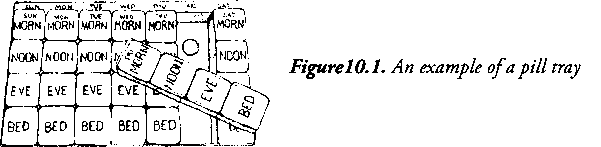
Remembering to take your supplements is important because when you go without them your symptoms may flare up and make doing anything at all difficult. We really like the pill tray in Figure 10.1 that has removable daily compartments. You can remove a compartment and take it with you as you go about your day rather than having to take the whole pillbox. The compartments are see-through so you can tell whether you took your supplements or not. The box will remind you to take your pills on time. Leave it out in a place you will see it all the time.
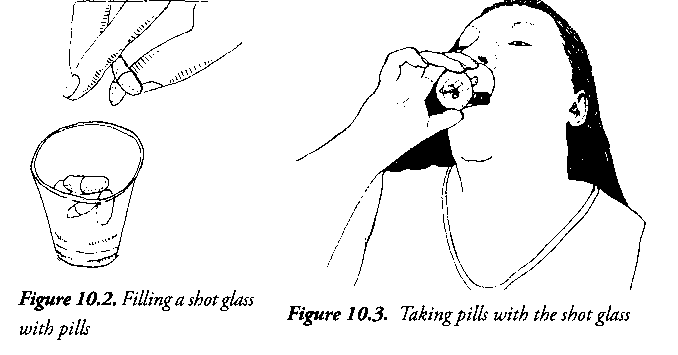
If you are clumsy, have tremors, have been finding pills on the floor or have trouble getting all the pills from the vitamin minder into your mouth you might want to pour the pills into a shot glass before you take them. This makes pill handling convenient and quick. Don’t fill the shot glass more than half way with pills. Usually eight to nine pills is the most anyone can swallow at one time. The goal here is not to take more pills at one time, but to not drop the pills you are taking.
10.1.2 Filling your pill tray
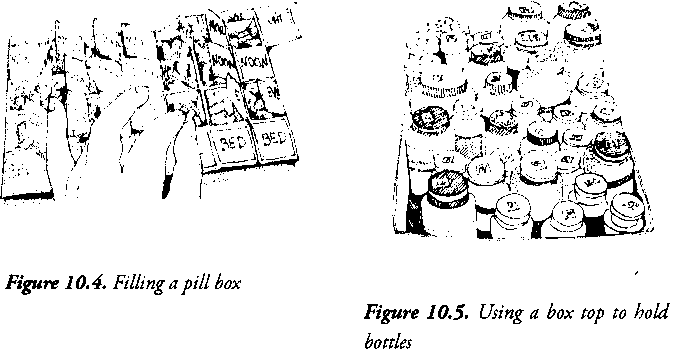
Pack up a pill minder once a week rather than deal with many bottles several times every day. It is surprising how difficult this simple task can be when your brain is addled by mercury poisoning. Try putting all your supplement bottles into a box top and taking them out one at a time as you fill your pill minder. When you have finished with one bottle, put it someplace else. When your box top has no more bottles in it, you are done with this weekly task. Numbering your supplement bottles may help, too. Just put a label on the cap with the number. That way you can make sure you didn’t miss any.
10.2 Remembering to take your chelators
The MOST important thing to remember is to take your chelator doses on schedule. You can forget your supplements from time to time, be early or late, or miss them entirely. But if you forget a chelator dose you have to abort the round, and that can make you feel really sick. It is also time lost in your quest for health. Everybody has forgotten to take their pill when the alarm went off. Don’t let it happen often. If you don’t make a scrupulous habit of immediately taking the pill as soon as you hear that alarm, we guarantee that you are going to wind up asking yourself, “did I take the darn thing or not?” You may wish to use a checklist to mark off when you take your pill. We know it sounds ridiculous, but you will be looking at it five minutes after you were supposed to take the pill because you won’t remember if you did or not. We both went through this. You will, too.
Here are a few good ideas for remembering to take your chelators.
10.2.1 Alarms
Cell phones have an alarm function where you can set multiple alarms.
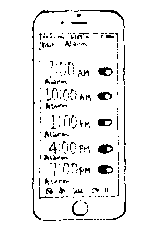
Figure 10.6
A cell phone with alarms set.
Failing that you can go to the drug store and buy a whole bunch of cheap alarm clocks and set them one after another like this:
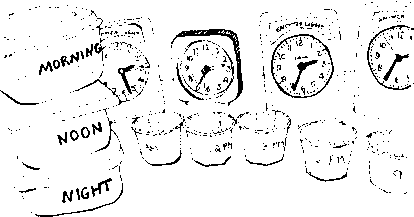
Figure 10.7.
A set of dial alarm clocks
The old style dial clocks are more convenient because they don’t know am from pm so you only need four to do every three hours around the clock. More modern digital alarms when they are set for 9 am won’t go off again at 9 pm, so you need eight of them.
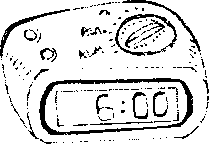
Figure 10.8.
A digital alarm clock
Another good option for keeping track of your chelation schedule is a vibrating alarm watch. They can be a bit challenging to program when you are feeling addled but they have the advantage of always being on your wrist. You can set them to ring or to vibrate or both. Many are available where you can set eight different alarms a day. Watches with up to 12 alarms a day are available.
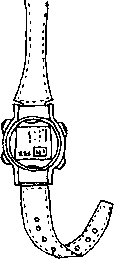
Figure 10.9.
An alarm watch
10.2.2 Labeled pill boxes and other strategies
This is a pill box with a slot to correspond to every single alarm and every single dose. If you can’t remember what you did just check the appropriate box and if the pill is still there you didn’t take it.
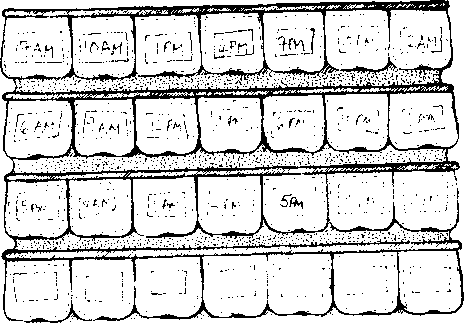
Figure 10.10.
A pill box with every dose labeled for a full round
10.2.3 Paper Cups
Another good system is stacks of little paper pill cups. You can write the dosage time on the outside of each cup. (See figure 10.7.)
10.2.4 Checklists
You can also keep a checklist to keep track of what is going on with your chelation schedule. Checklists can be done on paper or on a whiteboard.
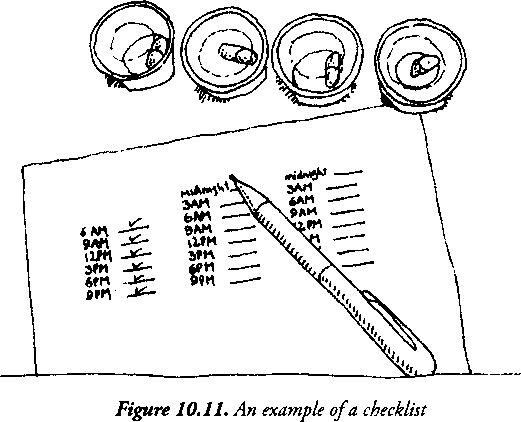
10.2.5 Your nighttime dose made easy
Keep your nighttime dose and a glass of water on a bedside table. This way, when the alarm goes off, you can just pop it in your mouth, take a gulp of water and go back to sleep. Be sure you arrange things in such a way that you can tell for sure whether you took that dose or not. You may need to put the alarm out of arm’s reach so you don’t just slap it and go back to sleep and forget your dose.
10.3 Keep a log or diary
An interesting phenomenon of human nature is how quickly we forget bad experiences. Keep a diary, otherwise you may not appreciate the actual progress you are making. A diary can also give you retrospective clues on things you did that hurt or helped. Perhaps you tried a new diet or a new supplement. If you have a symptom log you have some way of figuring out what happened.
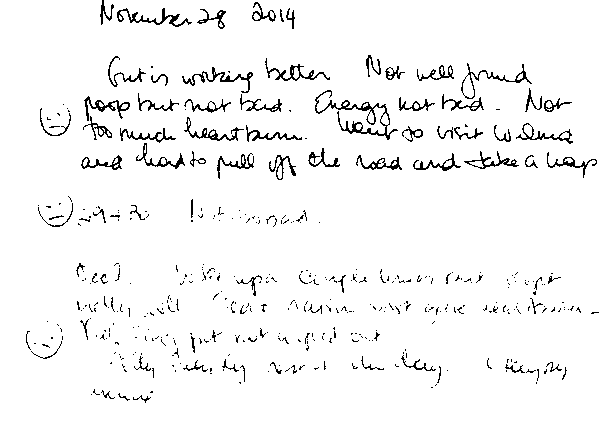
Figure 10.12.
This is from Rebeccas sporadic chelation diary.
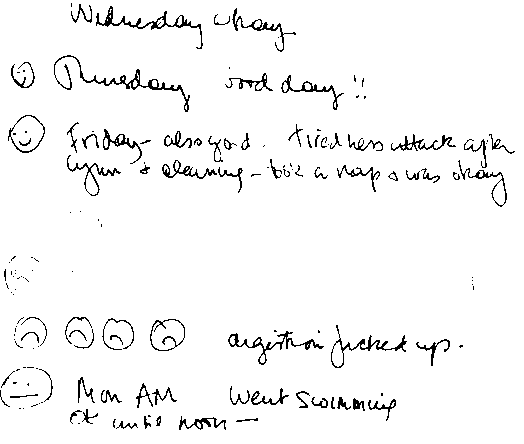
Figure 10.13 More of Rebeccas chelation diary. You just need to keep basic information like this.
10.4 Organizing the rest of your life
Many people with mercury don’t have anything visibly wrong with them. There is no label that social convention accepts as “serious.” It is not like cancer that people understand. Family, friends and doctors who are perfectly healthy themselves may consider you not to be sick, but rather some kind of malingering hypochondriac. They may find you self-absorbed and selfish. In the face of this attitude you may even start to doubt yourself and think that this is really all your fault. You may think it is something you are imagining and you should just try harder and have more discipline. This is not true! You are poisoned and you are sick and are taking valiant action to get better.
Getting better is now your most important job and everything else takes second place. Realize that you have a great deal less energy and time than a healthy person. Forget about getting stuff done. Just do the bare minimum you can get away with. Your new and important job is to heal. Keep in mind the instruction from the airline stewards to put on your own oxygen mask first if the plane loses air pressure. You are no help to anybody when you are sick, not even to yourself. Worry about great accomplishments after you are better. Right now, just accomplish taking your supplements and making it through the next chelation round. Small, everyday accomplishments like this will lead to the great accomplishment of recovery.
If you have the luck, which is both good and bad, to have a diagnosis accepted as “serious” and “not your fault,” like MS, Parkinson’s disease, lupus, diabetes or even irritable bowel syndrome, you will at least have some social acceptance that you are sick. It is unlikely you’ll get a lot of social acceptance and support however when you decide to chelate and get better instead of suffering a lot and dying the way society thinks you should.
Of course, if you have any psychiatric diagnoses, everyone will think you believe in mercury because you are crazy. People may even be obstructive when you try to control your diet, take supplements and chelate. You are not likely to get much in the way of respect or support in this situation.
With or without a diagnosis, and with or without a role to play as a sufferer of a “real disease,” one thing is certain, you are sick and you don’t have as much energy and focus as a healthy person. To remain functional at all, you’re going to have to put a lot of time and energy into diet, supplements, and whatever else it takes to keep your symptoms in check. Then you’ll need to chelate so you eventually get well. When you start out you’ll be putting energy and organization into chelating as well as everything else.
Get rid of unnecessary jobs and responsibilities. Explain what you are doing to your family and friends if they will listen, and get their support. Do it anyway even if they are not supportive. Prepare to concentrate on yourself and your health for a fairly long time. If you are lucky, you will start to feel better right off, but if you are one of the legion of people who have been poisoned for decades you can expect to spend a few years at this task. If you have savings, you may need to use them. This is the kind of thing people save for.
You will make some surprising discoveries concerning who really cares about you and who doesn’t, about whom you can or can’t trust. Don’t let this upset you. Be practical and pragmatic. You are doing something unusual that doesn’t fit in with a lot of people’s lives and beliefs. You may need to distance yourself from some people you are close to. When you get better you can pick up those relationships where you left off. On the other hand, a few people whom you may not be all that close to right now will be understanding and compassionate. Let them be your friends. Let them help you. Appreciate people who are willing to give you what you need rather than what they think you need. Be glad that people who respect your real needs are around and let them into your life.
If you have any choice about it, this is obviously not a good time to change jobs or start a business or to move away from a familiar or convenient location.
10.4.1 Some useful suggestions to make life easier
• put all your recurring bills like electricity, cable, water and so forth on automatic payment so you don’t have to worry about writing checks all the time.
• have a special table where you put all your bills and important business—and your vitamin minder box. Choose a place that you walk by and look at often.
• if you can possibly afford it, get a cleaning person to come in every one or two weeks
• get a month by month desk blotter sized calendar and put it on the wall near your phone where you can see it easily and it won’t get lost. Write your appointments on that and be sure to consult it every day. Keep two months visible so you can see the appointments and tasks due in the first few days of the next month. Don’t trust yourself to remember anything.
• buy a beautiful new notebook and a handsome pen and keep a diary. Or do it in a computer file. Keep records of how you feel and what you’re doing with your pills and activities—you’ll need this information for problem solving later.
• if you can’t make up your mind about something, flip a coin. Force yourself to make a decision. Few decisions are worth agonizing over. You’ll need all the mental energy you save doing this for something that’s actually important.
• make to-do lists and keep them on your special table described above. Do the most important task on the list first and when it is done, cross it off. When the list gets too long, throw it out and start over. If you don’t remember something, it wasn’t that important. If it really was important, it will come back to mind.