6 THE INS AND OUTS OF CHELATION
6.1 The Cutler protocol versus other methods
If you have been diagnosed with heavy metal toxicity by a doctor, chelation therapy is considered the standard of care. It is usually administered by IV or orally, in high, infrequent doses. Most doctors really hate chelating their patients. They don’t know how to do it properly and the patients wind up worse than before. Many doctors have shared stories with Andy from when they were residents. They describe watching their supervisors kill a patient with chelation. While textbooks don’t talk about this kind of outcome, doctors talk to each other more frankly.
There is no profit to be made by diagnosing and treating mercury poisoning. If there were, any chemist at any pharmaceutical company, by reading the same standard medical texts Andy read, would come up with this same protocol: low dose, oral (or transdermal) chelation based on the half-life of the chelators. Indeed, dosing on the half-life is how most drugs are used.
The proper use of chelators has not been researched by scientists or taught to doctors. This protocol uses the chelators alpha lipoic acid, DMSA and DMPS. In the United States, DMSA was approved as an ‘orphan drug’ so proper studies and groundwork weren’t done. DMPS is available because the usual means of approval were circumvented. Alpha lipoic acid is an over the counter nutritional supplement which almost no doctor realizes is a chelator.
How to use chelating agents properly flows from an understanding of the chemical kinetics— the pharmacokinetics
9 — of chelation. It is unusual for physicians to be familiar with kinetics even though the subject is spelled out in standard medical texts. Typically drug companies have specialized chemists who work out the relevant details during the extensive studies government regulators require before approving a drug.
Kinetics is the branch of chemistry in which Andy spent 15 years as a researcher and consultant and in which he got his PhD. It was not difficult for him to look up the relevant details regarding alpha lipoic acid, DMSA and DMPS and use them to determine a chelation protocol.
It is important to understand that a frequent, low dose chelation protocol is the right way to detoxify heavy metals ANY other way of detoxing heavy metals is the wrong way and dangerous. There are no “safe and natural” methods. Any method that does not use actual chelators dosed on their half-life
10 is the wrong way to do it. Some people have gotten better with other chelation protocols, it is true, but they were lucky and many others got very sick instead. There is about a one-in-six chance of hurting yourself badly with DMPS infusions, for instance
11 . Some of the other methods have a 100% adverse reaction rate. Mercury is poisonous stuff. When you move it around your body you have to do it the right way. Don’t play Russian roulette with your life and health! Learn how to detoxify yourself properly.
Be very cautious about taking the advice of doctors, naturopaths and other practitioners. They do not have the proper background or technical education to develop treatment protocols. When they prescribe medicines, they are relying on existing protocols developed by someone else with a very different background than a physician. You have been strongly socialized to trust physicians and nurses, but do not trust them for this! The Andy Cutler chelation protocol is the only way to remove metals safely. Any other way carries serious risk. Andy said he grew tired of getting emergency telephone calls from people who let their doctor persuade them to do something dangerous like a DMPS IV or oral alpha lipoic acid a few times a day to “support their mitochondria.”
The rules about how to take chelators and the warnings we give you are inflexible. Other parts of the protocol are flexible because they are not well defined scientifically and people really are different. How you decide to take supplements, for instance, is flexible, although some of them need to be taken three or four times a day in order for them to be effective.
6.2 How chelation works
The word chelation comes from the Greek word for claw. A true chelator molecule for mercury has two thiol (sulfur) groups, which are spaced an appropriate distance apart so they can fit around the mercury ion. Mercury is particularly attracted to thiol sulfur
12 , which is found in every cell in the body. When the chelator molecule comes along, it attaches itself to the mercury ion. The bond is strong and it rips the mercury away from wherever it is lodged.
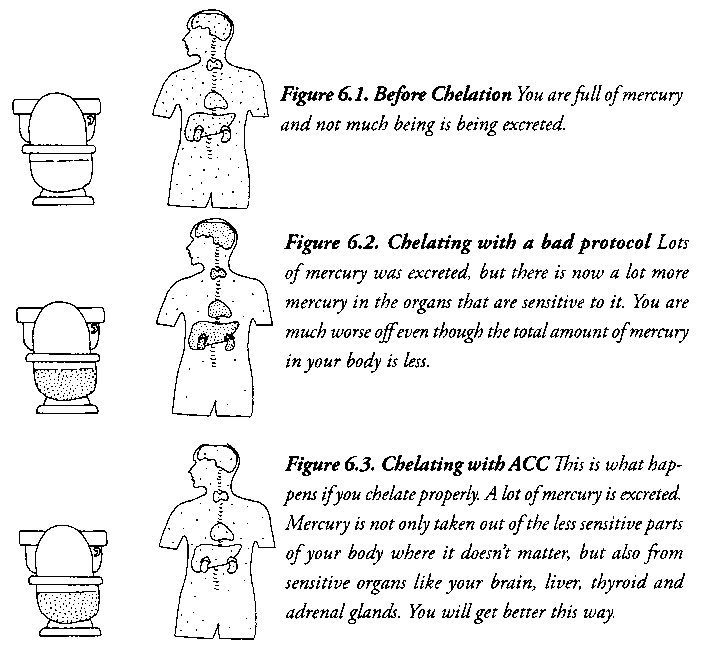
The chelator molecule, with its little payload, now flows along in the blood stream destined to be excreted. Unfortunately, it does not have a perfect grip and after a while it will lose its hold. The chelator has exceeded its half-life in the body and has started to dissipate. When this happens, the mercury will zip off and reattach itself to some other attractive, sulfury location. The Andy Cutler chelation protocol solves this problem by dosing the chelators on their half-lives. That way, when a chelator loses its grip on a metal ion, there is a fresh dose right behind ready to pick up what has been dropped. You need to have a constant blood level of chelator to keep redistribution from happening too much. This keeps the mercury moving out rather than around.
A harmful chelation protocol is one that moves the mercury around a lot before it can come out. This can cause preferential redistribution of mercury from less sensitive locations (like your muscles) to more sensitive locations (like your brain). The more sensitive tissues tend to have more thiol groups and a higher affinity for mercury.
The mercury in your muscles, bones, ligaments, lungs, skin, and fat is not hurting you because these are not sensitive tissues. It is the mercury in your brain, liver, thyroid, adrenal glands and immune system cells that is hurting you because these are sensitive tissues. In the process of moving mercury out, you do not want to inadvertently move any of it into the sensitive tissues as this will make you sicker, not better.
Even if the total amount of body mercury falls it doesn’t do you any good if the amount that is actually hurting you increases. This is why you have to follow the rules and chelate on a proper schedule. Chelating incorrectly may make a lot of mercury come out in the urine or stool but most of the mercury that is not eliminated will wind up some place worse than where it started. It is more difficult to get the mercury out of higher affinity tissue. It is going to be hard enough to remove the mercury already in your brain without adding more.
An unskilled doctor is one who goes by tests alone. A doctor using a harmful protocol will think the patient is getting better because mercury keeps coming out in the tests. They don’t notice the patient standing in front of them is getting worse. There is no test to show the mercury in the sensitive organs going up and the mercury in the tissues where it doesn’t matter going down. The end result is a patient who is even sicker and is going to take a lot longer to get better, and a doctor who thinks they’ve done a great job because the reports from the lab look so good.
You are going to be naturally inclined to trust your doctor. Don’t be too trusting! You are probably going through “Health Care Hell” right now, at great expense, because you trusted a doctor or a dentist who poisoned you!
It doesn’t matter what kind of doctor they are, MD, DO, ND, NMD, DC, DDS, DMD or NPs. They are all taught in school how to chelate you wrong! They are all taught in school that they know everything they need to know and they shouldn’t have to listen to anyone else.
Unfortunately, the chelators don’t listen to doctors. They do whatever the laws of nature require. If the doctor prescribes chelators wrong, as they’ve all been taught to do, it will make you sicker, not better. It doesn’t matter how nice the doctor is or what fancy credentials he has. Chemicals don’t pay any attention to that at all.
Overcome your conditioning and be skeptical so that you don’t get hurt even more! As far as chelating is concerned, doctors and dentists lack the technical knowledge to avoid hurting you. Know what you want and make sure you get it. Don’t let any health care professional sway you, even if they are the nicest person in the world.
6.3 The chelating agents and waiting periods for taking them
6.3.1 The chelators we use for the ACC protocol
Table 6.1
The chelators we use for the ACC protocol
CHELATOR
DOSING
WHAT IT DOES
ALA (alpha lipoic acid, may also be called thioctic acid)
• every 3 hours or more often
• every 4 hours at night if this is tolerated and waking up is an issue
• can be started 3 months after last exposure to mercury
• is the only chelator that can cross the lipid barriers into the brain, organs and cells
• is the main chelator that everyone needs to use to clear mercury out of their body
• chelates mercury, arsenic and cadmium but not lead
• is excreted mostly via bile through the liver, but significant amounts also leave via the kidneys
Table 6.1
The chelators we use for the ACC protocol
CHELATOR
DOSING
WHAT IT DOES
DMSA
(dimercaptosuccinic
acid)
• every 4 hours or more often
•can be started 4 days after last exposure to mercury
• chelates extracellular mercury, lead, cadmium, antimony and arsenic
• may speed up excretion of mercury when used with ALA
• helps with symptoms when chelating with ALA
• can be used during the times one is not able to take ALA
• is excreted through the kidneys
• may exacerbate yeast
DMPS
(dimercaptopropane sulfonate sodium, a
pharmacist puts ‘sodium’ last, a chemist puts it first)
• every 8 hours or more often
•can be started 4 days after last exposure to mercury
• chelates extracellular mercury, arsenic and antimony
• may speed up mercury excretion when used with ALA
• helps with symptoms and does a better job at it than DMSA
• can be used during the times one is not able to take ALA
• not useful for chelating lead
• is excreted through the kidney
6.3.2 The waiting periods for taking chelators
You must wait four days from your last mercury exposure before taking DMSA or DMPS. You must wait three months from your last exposure before taking alpha lipoic acid. You can also choose to take no chelators at all for three months after your last exposure. You will still experience some relief during these three months even if you do not chelate. You should still take all the vitamins and minerals we talk about even if you choose not to chelate during this time. In fact, you should start taking them right now and not stop until you are all better.
Here is a typical scenario is a person who gets their amalgams removed:
• they start the essential four supplements at least two weeks before starting chelation. The sooner the better.
• four days after final amalgam removal, they can start DMSA or DMPS.
• three months after final amalgam removal, they can take alpha lipoic acid and DMSA or alpha lipoic acid and DMPS or alpha lipoic acid on its own.
• or they can take no chelator for three months and then start alpha lipoic acid on its own.
• or they can wait longer than the four days and the three months waiting period to take any of the agents above. They just can’t start sooner.
6.3.3 Why these waiting periods are important
The four-day waiting period for DMSA and DMPS allows time for any residual mercury source like amalgam dust or chips to be washed off your skin, pass through your digestive tract and get sneezed out of your nose. Chelating while in direct contact with a mercury source may cause you to absorb more of it. Chelators get into all your bodily fluids and can dissolve mercury out of something like an amalgam chip. This dissolved and chelated mercury is easy to absorb.
The three-month period before taking alpha lipoic acid gives time for recent exposures of mercury to clear out of your bloodstream. Chelating with alpha lipoic acid, at this point, would cause mercury to get into your brain, organs or cells. This is because alpha lipoic acid is fat soluble. It allows the chelated mercury to pass back and forth across cell membranes and the blood brain barrier. If there is more mercury outside the brain than inside the brain your body’s natural drive to seek equilibrium will make the levels of mercury in the brain go up rather than down. The waiting period for alpha lipoic acid gives time for the mercury level outside the brain to drop lower than the mercury level inside the brain. That way, when the alpha lipoic acid allows the mercury to pass back and forth, the levels in the brain will go down, rather than up.
6.4 Which chelator to choose and how much to take
The only necessary chelator for getting mercury out of your body is alpha lipoic acid. You will have to decide for yourself whether to take alpha lipoic acid on its own or to use it with one of the other “accessory” chelators, which are DMSA and DMPS. This choice will depend on what other metals may be an issue, where you are in the protocol and how the chelators make you feel. It will also depend on practical issues such as cost, ability to get the different chelators and legalities in your jurisdiction.
Opinions differ on what chelator dosage to start off with. In the online chelation support forums, Rebecca and her colleagues tend to tell people to start at 12.5 mg of whichever chelator they choose. All three chelators are dosed at the same level.
12.5 mg is a conservative amount, but the people who show up on the online forums tend to be sicker and more sensitive than average. We have certainly seen people who could barely tolerate 1 mg of chelator when they started off! Yet others do fine at 50 or 100 from the beginning. For the purposes of this book, we suggest starting with 25 or 50 mg of chelator. People who are very sick or very sensitive may have to start lower. People who are very sensitive to thiols (see section 9.3.) will need to start with low doses of alpha lipoic acid. People who do well on thiols will be able to tolerate more robust dosages.
Your first round is a trial to see how the chelator makes you feel. If you are very sensitive or you can’t afford to be out of commission for a few days, start low. The worst that will happen if you start too low is you may waste a few weeks in dosage adjustment.
Typical side effects are feeling tired, bad tempered and depressed. These side effects will often build up as you go along in the chelation round. The worst day is usually the day after you stop. If a couple of days after the round you can look back and think that the whole experience was bearable, then you’re at about the right dose.
The side effects tend build up as the round goes on. Your dose is certainly too high if you are having hard to tolerate side effects on day one. In this case, just stop. Wait to start a new round at a lower dose the following week.
Fifty or 100 mg of any chelator is enough to get better. Higher doses may speed things up somewhat, but a lot less than you think 5 High doses are useful because side effects will let you know where you stand in regards to chelatable toxins.
People have varied and individual responses to drugs, supplements and foods. There are bound to be a few people who will have trouble with more or less anything we’ve mentioned in this book. If you think you are reacting poorly to a chelator or a supplement, stop taking it! If you get a rash while taking DMPS, or a lot of yeast problems, ringworm, or boils while taking DMSA, stop taking it. If these agents are important to your detoxification you will need to learn more about them and their risks of potentially very nasty adverse reactions before considering taking them again.
Alpha lipoic acid is a different issue. It is the main chelator that crosses the blood brain and other lipid barriers. You have to use it in order to recover. If you find you can’t tolerate it, you need to try cutting down the dose until you can. If that doesn’t work, you should chelate for several months with one of the other chelators, usually DMPS, and then try again with alpha lipoic acid.
6.5 What NOT to do!!!!
Mercury is extremely poisonous and moving it around your body is dangerous. Don’t try random things! Here is a list of things never to do:

• chelating with amalgam fillings —Amalgam fillings are a reservoir of available mercury. If you take chelators while you have amalgam fillings in your mouth, they will pick up and redistribute mercury from this pool. You will get very, very sick. Do not attempt to detoxify or chelate in any way (other than sauna) with amalgam fillings in your teeth.
• taking chelators in any other way than dosed on their half-life
—Doctors commonly prescribe detoxification protocols that involve taking infrequent doses of chelators. This will make you sicker than you already are. Chelating this way causes the mercury to move around and get redistributed to sensitive tissues rather than excreted. Chelators must be dosed on their half-lives or not at all. Do not take alpha lipoic acid or any other chelator in an IV or injection. Do not take alpha lipoic acid or any other chelator on anything but a proper chelation schedule.
• cilantro
—From the horror stories we hear from people who tried to detox with cilantro, we think that it contains an actual chelator that crosses the blood brain barrier similar to alpha lipoic acid. Nobody knows the active ingredient in cilantro. Nobody knows its half-life. There are no standardized extracts so it is impossible to use properly. Although it is indeed “perfectly natural” so are botulism, strychnine and hemlock. Some of the worst stories of regression we have heard come from people who juiced cilantro or made cilantro smoothies or salads.
• using chelators that don’t work and are dangerous—EDTA is not a clinically useful chelator for mercury even though it increases the amount of mercury that shows up in the urine. In an actual human body, it does not chelate mercury from sensitive organs or clear it from the body. Using EDTA will make you get worse by moving mercury from harmless locations into your brain and other sensitive organs. EDTA does chelate lead very effectively, but DMSA chelates lead better. Do not use EDTA unless you have removed all amalgam fillings and done several years of chelating with alpha lipoic acid and are sure all the mercury is gone from your body.
EDTA can be used to clear minerals out of clogged arteries. If you are in an extreme health situation, such as needing bypass surgery, the risk of mercury poisoning from using EDTA may be less than the risk of a heart attack. But if your goal is to get rid of mercury or lead, skip the EDTA. Do not let any “detox doctors” give you EDTA suppositories, IV s or capsules.
chlorella and other “detox supplements”—A true chelator has two thiol groups
15 that latch on to the mercury ion securely enough to get it moving along out of the body. Chlorella is full of various molecules that have only one thiol group, so it picks up the mercury but doesn’t cause it to be excreted. In nature, chlorella can absorb heavy metals (and is often contaminated with them). In nature, it absorbs heavy metals from the inorganic environment, which has few thiols. Living bodies have many thiols and the chlorella does not react with them in the same way. It does not absorb heavy metals in a living body. It causes redistribution.
* using alpha lipoic acid for anything other than chelating —Chemicals do not care what you think they should do, or what the most important doctor in the world tells them to do. Chemicals act entirely according to the laws of nature. If your doctor lectures his syringe before giving you an injection, it is not going to change the outcome.
Many doctors prescribe alpha lipoic acid because it is a powerful antioxidant. A common recommendation we have heard is 600 mg a day to treat diabetic neuropathy. Apparently, it is effective for that, but it is also a chelator, alas. Over time, if you have any mercury in your body, chelating improperly will concentrate it in to your brain and other sensitive organs. The alpha lipoic acid acts as both as an antioxidant and a chelator at the same time. The doctor and the patient will usually not realize that the neurological issues that slowly develop are due to the misuse of alpha lipoic acid.
Using alpha lipoic acid improperly will eventually result in new, horrible, long lasting symptoms like brain damage and insanity. Do not use alpha lipoic acid improperly. Always dose alpha lipoic acid on its half-life. Do not use alpha lipoic acid prior to 3 months after your last exposure to mercury.
• intravenous anything except vitamin C —Many doctors who treat heavy metals will prescribe IVs. An IV of a chelator is a hazardous proposition as it will mobilize a huge amount of mercury and the bulk of it will be redistributed. For case reports about what can happen, see www.DMPSbackfire.com.
An IV of vitamin C is the only kind that we recommend. It can provide enormous short-term symptom relief. Just be careful the doctor doesn’t put something else he thinks may be good for you into the IV bag. It should only contain vitamin C, calcium gluconate, magnesium chloride or sulfate, and unpreserved sterile water or half normal saline for injection.
• never do glutathione IVs —A glutathione IV will mobilize mercury and cause an enormous “redistribution event” without getting any of it out of the body. It is common for people to become mentally ill and develop bipolar disorder as well as many other problems after these infusions. A glutathione IV will provide only temporary symptom relief at best. It won’t remove any toxic metal from where it is doing damage. The most dangerous aspect of glutathione IVs is that people often have several good experiences with them, so they ignore warnings and keep on going until the bad one hits and causes catastrophic, long-lasting damage.
• challenge tests —Challenge tests are faddish and popular. They provide no useful information. They are also dangerous because of the huge dose of chelators. Never agree to do one.
liver flushes —These are simply too hard on your mercury toxic liver.
• homeopathic detox remedies —Homeopathy can be useful for symptom control and we are not against using it. But homeopathy depends on the body’s natural mechanisms. The body has no natural way to detoxify mercury and detox remedies have consistently made people worse. Do not use any “homeopathic heavy metal detox” remedies.
6.5.1 Supplements never, ever to take
Table 6.2
Supplements to avoid
Supplement (or medication)
Discussion
alpha lipoic acid (ALA)
Should only be used for chelating on a proper schedule.
cilantro* (coriander leaf)
•Cilantro is an actual chelator. Nobody knows enough about it to use it safely.
colloidal silver or any other form of silver topically or internally such as sulfalazine silver, silver nitrate sticks
Silver is a toxic element which accumulates and is almost impossible to chelate.
copper
Mercury toxic people tend to accumulate too much copper.
dandelion
This is hard on the liver. It makes a lot of mercury toxic people who use it sick, often after it has been tolerated for some time.
EDTA
Forms a dangerous compound with mercury. Trace amounts as a preservative in foods or cosmetics are okay.
IMD
A proprietary formula of unknown composition that our experience suggests some people do not tolerate well. It is held out as binding metals in the intestines, which is not useful for detoxification.
- Also avoid eating this as a food, e.g. in guacamole, salsa, breakfast sausages.
Table 6.2
Supplements to avoid
iron
Do not take it just because your blood levels (ferritin) are low. Only take it if you also have low MCV and MCH on your blood count (small red blood cells, microcytic anemia), then at half dose.
manganese
Can be a synergistic toxin for people with mercury poisoning.
mercurochrome
The active ingredient is mercury. It absorbs into your body.
merthiolate
The active ingredient is mercury. It absorbs into your body.
methionine, l-methionine, dl-methionine
Does not chelate or detox anything. Often causes agitation and emotional distress.
MMS, Miracle Mineral Solution,
Master Mineral Solution or chlorine dioxide
Don’t use this. Don’t drink bleach. Don’t take poison.
penicillamine (Cuprimine) or N-acetylpenicillamine
Tends to redistribute mercury rather than cause it to be excreted. Adverse reactions are common.
R-alpha lipoic acid or R-ALA
Consistendy makes people ill no matter what the schedule.
thioctic acid
This is another name for alpha lipoic acid (ALA).
TTFD (thiamin tetrahydrofurfuryl disulfide)
Doesn’t detoxify anything. Contains a poisonous petrochemical. Thiamin or benfotiamin are safe and equivalent.
vitamin D
Do not take it just because your blood test is low. Only take it if you have frank deficiency symptoms such as fatigue, seasonal depression and getting sick easily.
You must constantly check all combination products (like multivitamins) for any of the ingredients listed above. It is easy to forget what you have and haven’t checked. Formulations change all the time.
6.5-2
Supplements some people need to avoid
If you are taking, or plan to take the following, read about thiol sensitivity in section 9.3.
Table 6.3
Supplements some people need to avoid
acetylcysteine
glutathione (oral)
allicin
1-cysteine
brown rice protein
MSM
curcumin
n-acetylcysteine (NAC)
DMSO
pea protein
fenugreek
turmeric
garlic capsules
whey protein
6.5.3 Avoid medical mercury!
• do not get flu shots. These shots are full of mercury, don’t prevent the flu and make you more likely to get sick<.
• do not get any vaccines, whether or not they contain mercury. Vaccines can cause many autoimmune diseases which mercury poisoned people are very prone to developing. You can easily be told there’s no mercury in vaccines any more, then be given one that is loaded with mercury. This is very politicized and
19 doctors and nurses think it is OK to lie. Their supervisors and pharmaceutical sales representatives often lie to THEM about the mercury content of vaccines
If you find yourself in the emergency room with a nurse vehemently insisting you can get tetanus and die if you don’t get a tetanus shot RIGHT NOW, ignore her. That’s nonsense. It takes 4-6 weeks before the tetanus shot is effective. You are relying on your LAST tetanus shot to cover you for THIS cut. You have plenty of time to decide if you need a tetanus shot later. We know of many cases of mercury toxic adults who got much worse when they got a tetanus shot.
• do not get any silver filling even if the dentist says they no longer have mercury in them (they still do). Do not let a dentist place a crown on a tooth with an amalgam filling in it without removing all the amalgam first. Make him show you a bite wing X-ray of the tooth before putting the crown on to prove there is no mercury left.
• watch out for the mercury preservative thimerosal and any compound of mercury, as it can be found in many medical products. Examples are eye drops, nose drops and vaccines.
• do not use mercurochrome or any other mercury based antiseptics.
6.5.4 No other medical metals either!!!
You are already toxic with at least one metal. Don’t add any more to the list or you will get much sicker and more difficult to detoxify. Make sure the treatment you are considering is not worse than the disease.
• no Pepto Bismol or bismuth containing stomach remedies. Bismuth
20 is often combined with H2 blockers, and routinely used to treat H. Pylorii.
• no sulfalazine silver or silver nitrate sticks.
• no colloidal silver or nano silver.
• if you are offered chemotherapy, do not take Trisenox which contains arsenic, or cisplatin (Platinol) or carboplatin (Paraplatin) which contain platinum, unless there is no good alternative.
6.5.5 No drugs that are dangerous for people with mercury poisoning!
Some drugs are much more dangerous for people with mercury than for others, even if their kidney function is completely normal.
* Avoid diuretics that deplete your already low magnesium and potassium
Table 6.4
Diuretics
Generic drug name
Tradename
bendoflumethiazide
chlorothiazide
Diuril
chlorthalidone
Hygroton
hydrochlorothiazide
hydroflumtthiazide
indapamide
Lozol
methyclothiazide
metolazone
Zaroxolyn
polythiazide
* Avoid MRI contrast agents containing gadolinium
Table 6.5
MRI contrast agents containing
gadolinium
Ablavar
Gadavist
Omniscan
ProHance
Dotarem
Magnevist
OptiMARK
Eovist
MultiHance
Primovist
Most of the time when the doctor says they need to use it, they don’t. It just lets them bill insurance for twice as much.
* Avoid fluoroquinolone antibiotics— The fluoroquinolone class of antibiotics has a risk of adverse reactions in which your tendons rupture, your muscles fall apart, the nerves in your hands and feet don’t work right and your brain stops working properly. These reactions appear irreversible. Nobody should take these antibiotics if another kind will do. People with mercury poisoning seem especially likely to develop these severe and lifelong problems.
Avoid these antibiotics:
Table 6.6
Fluoroquinolone antibiotics
Generic name
Trade name
ciprofloxacin
Cipro
gemifloxacin
Factive
levofloxacin
Levaquin
moxifloxacin
Avelox
norfloxacin
Noroxin
ofloxacin
Floxin, Ocuflox
The high magnesium on the hair test means the body is excreting it and needs more.
To do this test with children see
Fight Autism and Win (second edition)
www.directlabs.com Search for “Doctors Data” and choose the test labeled “Hair Toxic & Essential Elements-Doctor s Data Kit.”
It is useless for children (those under eighteen years of age).
Pregnant and lactating women can exhibit an “all low” profile which satisfies rule one, even if they are not toxic.
In a technical sense meeting a rule means there is more than a 97.5% chance mercury is causing you problems. This corresponds to how standard medical laboratories provide ‘normal ranges’ for their tests. The finer gradations between “abnormal” and normal” are discussed on page 26 of
Hair Test Interpretation: Finding Hidden Toxicities.
Pregnant and lactating women can exhibit an “all low” profile which satisfies rule one, even if they are not toxic.
From The Merck Manuals ( www.merckmanuals.com/professional/clinical-pharma-cology/pharmacokinetics/overview-of-pharmacokinetics ): “Pharmacokinetics, sometimes described as what the body does to a drug, refers to the movement of drug (sic) into, through, and out of the body-the time course of its absorption, bioavailability, metabolism, and excretion.”
The half-life is the time it takes for the concentration of a substance to fall to half its original value. For substances with what is called first order kinetics, this number is a fundamental constant. It is often loosely used for other materials such as alpha lipoic acid in place of more accurate phrases like characteristic time.’
See www.dmpsbackfire.com or cutlersuccesstories.weebly.com/what-not-to-do.html for typical outcomes.
Thiols are one particular chemical form of sulfur. Among other things they’re what make skunks stink and natural gas smell bad. They may also be called sulfhydryl groups.
See section 6.1 for a discussion on half-life.
By cilantro we mean the leaves of the coriander plant
(Coriandrum sativum).
or other binding groups. E. g. EDTA has carboxylic acid groups and amines. Thiols are highly selective for heavy metals like mercury and do not get blocked by binding to calcium, magnesium and other light metals in the body. For this practical reason the only chelators relevant to this book are dithiol chelators.
Dimicheli V, et al, “Vaccines for preventing influenza in healthy adults.” Cochrane Database of Systematic Reviews 2014, Issue 3. Art. No.: CD001269. Onlinelibrary. wiley.com/doi/10.1002/14651858.CDOO1269.pub5/epdf.
“Flu shots are known by the medical profession to prevent on average 1 case of respiratory illness for every 40 flu shots given. ”
Benjamin J. Cowling, Vicky J. Fang, Hiroshi Nishiura, Kwok-Hung Chan, Sophia Ng, Dennis K. M. Ip, Susan S. Chiu, Gabriel M. Leung, J. S. Malik Peiris, “Increased Risk of Noninfluenza Respiratory Virus Infections Associated With Receipt of Inactivated Influenza Vaccine,” Clinical Infectious Diseases, Volume 34, Issue 12, 15 June 2012, Pages 1778-1783, doi.org/10.1093/cid/cis307
Leftover flu shots contain enough mercury to be hazardous waste. It is a federal crime to throw them in the garbage or put them down the drain. Children given flu shots are known to suffer more frequent respiratory infections than those not given flu shots: 30% of nurses refuse flu shots. Many hospitals buy mercury-free flu shots for staff but give mercury containing ones to their patients.
If the inside of the pill is pink, be suspicious! Read the package carefully.