7 HOW TO FOLLOW THE ANDY CUTLER CHELATION PROTOCOL
7.1 Some considerations before starting
• double check for residual amalgam by getting your mouth X-rayed and checked by a competent dentist. All mercury, down to the tiniest fleck, needs to be removed. Ask for digital bitewing X-rays. If in doubt, check yet again. Crowns, which are impermeable to X-rays may pose a problem. This is discussed in section 5.1.1.
• take the following essential supplements for at least two weeks before starting to chelate. This is the same list as in the introduction. Hopefully, you are already doing this. You may also take the other basic supplements if you find them helpful.
These supplements should be taken three, or better four times per day.
• chemically sensitive people or people with severe allergies may need to try various brands and types of these supplements. For example, most vitamin C is made from corn syrup, but you can also find brands made from beet sugar, sago palm, cassava or potatoes. Vitamin E is from soy. If you are so reactive to soy you can’t take vitamin E, try tocotrienols instead.
Table 7.1
The core four essential supplements
Supplement
How much and how often
magnesium e.g. citrate, glycinate, malate*
100 to 200 mg, three or four times a day (with meals and at bedtime)
vitamin C, Buffered **
1 to 2 gm, three or four times a day (with meals and at bedtime). You can also take an additional 250-500 mg with each chelator dose.
vitamin E (natural or d-form)
1,000 IU per day
zinc
50 mg one a day with a meal
- Do not use oxide, hydroxide or carbonate because they are poorly absorbed. Other forms are fine.
**Vitamin C is an acid. If you take the ascorbic acid form it may give you heartburn. Buffering prevents this.
Table 7.2
Other basic supplements you may need
Supplement
How much and how often
Why
adrenal cortex*
50 to 250 mg, three or four times a day
details in section 8.3.2
phosphatidylcholine (lecithin)
One to two gm with meals and at bedtime
details in section 8.7.2 (liver), 8.10.2 (concentration and mood) and 8.11.2 (depression)
omega 3 oil: fish or flax
Up to three tbsp (about 45 ml) flax oil or one tbsp (about 15 ml) fish oil daily
details in section 8.10.2 (concentration and mood) and 8.11.2 (depression)
vitamin A
25,000 IU per day
increases immunity
- Be careful to get “adrenal cortex” and not a whole adrenal product that contains both the adrenal cortex and the adrenal medulla.
7.2 The protocol
7.2.1 The first three months after amalgam removal or your last exposure to mercury
1. You can start DMSA or DMPS four days after your last exposure to mercury. In most cases this means four days after getting your last amalgam removed. You can also choose to take no chelators at all at this point.
2. Start with between 25 and 50 mg of DMSA or DMPS.
3. You take DMSA every four hours or less, you take DMPS every eight hours or less.
4. The minimum round is three days and the intervening two nights, which is about 64 hours. The rest of the week is used to recover. DO NOT SKIP THE NIGHTTIME DOSES!
5. You can do longer but never shorter rounds. Be sure to take at least four days off between rounds to recover.
6. If you miss the scheduled dose of DMSA by more than one hour or DMPS by more than two hours, stop the round and start over the following week.
7. If you’ve missed a dose and taken the next one anyway, continue the round to the end and expect to experience substantial side effects.
8. If you take a double dose by mistake continue the round as though nothing had happened.
9. Never increase or decrease dose, change chelators or vary the timing in the middle of a round. This is how you decide if you are at the right dose:
• if your symptoms are bearable, stay at your starting dose.
• if they are really awful and you can’t stand it stop and halve your dose the next round. If you felt your experience was especially bad you can reduce it even more than this.
• if you don’t feel anything you can double your dose on the next and every new round until you find the dose that is appropriate for you. If you are a person with a lot of symptoms or are very sensitive to everything, increase your dose by 50% or less.
• the appropriate dose is where you feel something is happening but it is tolerable. The side effects shouldn’t be so bad that you can’t chelate every week or every other week. Feeling tired, cranky and depressed the day after the round ends is normal. If you continue to feel worse for more than one day, the dose is too high. You should be able to continue with your normal life and obligations.
10. Once you have found your tolerated dose, stay with it for about six months. At this point, if you feel you can tolerate your chosen dose well, you may try to increase. Adjust it up until you find a new tolerated dose. We suggest a 50% increase at first, but use your own judgment as to how cautious you wish to be based on how sensitive you are.
11. Each time you increase your dose, you should stay at that level for about two months, although the decision about when and how much to increase is highly individual.
7.2.2 Adding alpha lipoic acid after three months
(We have repeated some of the information in the section above word for word so you don’t have to go back and forth and risk losing your place.)
After three months have elapsed since your last exposure, you can add ALA to your chelating rounds. For most adults, their last exposure was the date their last amalgam filling was removed.
1. You can take alpha lipoic acid with DMSA or alpha lipoic acid with DMPS, or alpha lipoic acid by itself.
2. Start with between 25 to 50 mg of alpha lipoic acid. If you are sulfur food sensitive
1 start low, perhaps 12.5 mg. or even less. If you need a lot of sulfur foods, you’ll likely do well with a generous dose.
3. You take alpha lipoic acid every three hours or less. At night, you can take it every four hours in order to have less interrupted sleep. YOU MUST NOT SKIP THE NIGHTTIME DOSES! Most people are OK with dosing every four hours at night, but some people need to stay at every three hours around the clock. A few may need even more frequent dosing. Dosing more frequently reduces side effects.
4. If you are taking alpha lipoic acid with another chelator you should adjust the other chelator’s schedule to fit the alpha lipoic acid schedule. For instance, take the DMSA every three hours along with the alpha lipoic acid, or take the DMPS every second dose of alpha lipoic acid.
5. The minimum round is three days and the intervening two nights, which is about 64 hours. The rest of the week is used to recover.
6. You can do longer but never shorter rounds. Be sure to take at least four days off to recover.
7. A certain amount of experimentation may be needed to figure out which combination of chelators is right for you. Usually, however, alpha lipoic acid and DMPS is the best combination for controlling symptoms.
8. If you miss your scheduled dose of alpha lipoic acid by more than 1 1/2 hours, (1/2 hour for the night time four hours scheduling of alpha lipoic acid), stop the round and start over the following week.
9. If you’ve missed a dose and taken the next one anyway, continue the round to the end and expect to experience significant side effects.
10. If you take a double dose by mistake continue the round as if nothing had happened.
11. Never increase or decrease the dose or change chelators or timing in the middle of a round.
12. This is how you decide if you are at the right dose:
• if your symptoms are bearable, stay at your starting dose.
• if they are really awful and you can’t stand it, stop and halve your dose the next round. If you felt your experience was especially bad you can reduce it even more than this.
• if you don’t feel anything you can double your dose on the next and every new round until you find the dose that is appropriate for you. If you are a person with a lot of symptoms or are very sensitive to everything, increase your dose by 50% or less.
• the appropriate dose is where you feel something is happening but it is tolerable. The side effects shouldn’t be so bad that you can’t chelate every week or every other week. Feeling tired, cranky and depressed the day after the round ends is normal.
If you continue to feel worse for more than one day, the dose is too high. You should be able to continue with your normal life and obligations.
13. Once you have found your initial tolerated dose stay on it for about six months. At this point, if you feel you can tolerate your chosen dose well, you may increase. Adjust it up until you find a new tolerated dose. We suggest a 50% increase at first, but use your own judgment based on how sensitive you are as to how cautious you wish to be with this increase.
14. Each time you increase your dose, you should stay at that level for about two months, although the decision about when and how much to increase is highly individual.
15. Do not add or subtract chelators during a round.
7.2.3 Schedules for taking supplements
Here are some examples of chelation schedules:
Table 7.3
Chelator schedule: every 3 hours. Use for alpha lipoic acid or alpha lipoic acid and DMSA
Day 1
Day 2
Day 3
Start
12 am
12 am
6 am
3 am
3 am
9 am
6 am
6 am
12 pm
9 am
9 am
3 pm
12 pm
12 pm
6 pm
3 pm
3 pm
9 pm
6 pm
6 pm
9 pm
Stop
Table 7.3
.
This is the most common type of schedule.
Table
7.4
Chelator scheudle: every 4 hours. Use for DMSA
Day 1
Day 2
Day 3
Start
3 am
3 am
7 am
7 am
7 am
11 am
1 lam
11 am
3 pm
3 pm
3 pm
7 pm
7 pm
7 pm
11 pm
11 pm
11 pm
Stop
Table
7,4. Easyy regular and convenient. Alarms are necessary at least at night. Alarms and a checklist are helpful and we strongly suggest you use them, but on this schedule you may be able to simply watch the clock and remember to take your dose.
Table 7.5
Chelator schedule: three hour schedule with four hours at night Use for alpha lipoic acid only or alpha lipoic acid and DMSA
Day 1
Day 2
Day 3
Start
2 am
1 am
7 am
6 am
5 am
10 am
9 am
8 am
1 pm
12 pm
11 am
4 pm
3 pm
1 pm
7 pm
6 pm
5 pm
10 pm
9 pm
8 pm
11 pm
Stop
Table 7.5.
Due to the varying time interval between doses, this schedule does not conveniently work out to be the same time every day. You’ll want to make a check list and mark off each dose as taken to keep track. You will need to set alarms.
If you have bad symptoms on a round it sometimes helps to shorten the interval between chelator doses. This may seem counterintuitive, but shortening dosing intervals stabilizes blood chelator levels further and minimizes redistribution. For instance, take the alpha lipoic acid every two hours or two and a half hours rather than three. Two hour and 40 minute dosing is particularly convenient because dosing happens at the same time every day. This schedule is given as an example below.
Table 7.6
Chelator schedule: two hour 40 minute dosing schedule Use for alpha lipoic acid or alpha lipoic acid and DMSA
Day 1
Day 2
Day 3
Start
1 am
1 am
6:20 am
3:40 am
3:40 am
8 am
6:20 am
6:20 am
10:40 am
8 am
8 am
1:20 pm
10:40 am
10:40 am
5 pm
1:20 pm
1:20 pm
7:40 pm
5 pm
5 pm
10:20 pm
7:40 pm
7:40 pm
10:20 pm
10:20 pm
Stop
Table 7,6.
You will definitely need alarms and checklists to keep track of a dosing schedule like this. It is worth doing if it makes chelation more comfortable.
7.3 How long does this take?
Unfortunately, the answer to this question is different for every person. It is usually a long time. You can consider yourself done when you can get to 200 or 300 mg of alpha lipoic acid without any side effects and without any further improvements. At that point, you should continue chelating for another six months just to be sure. From start to finish the process can take between one to five years or more, but much relief occurs along the way. There is no way to tell how long it is going to take any particular person, so stop worrying and start chelating!
Barring some extremely rare genetic issue, your body is designed to be healthy. Poisonous metals make it hard for it to be in this healthy state. Every round you do makes it easier for your body to readjust back to health. This can take a long time and there can be a “roller coaster” or a “two step forward one step back” element. Chelating is not difficult, complicated or expensive, but it is not fast or exciting, either. It is a tedious job, but you need to make it your new way of life until you feel well again. It requires patience and persistence to chelate heavy metals out of your body and recover your health.
7.4 If you are having a difficult time chelating
If you are having a difficult time chelating, you may be taking a dose of chelator that is too high, or not using enough supporting supplements. Some people also find that shortening the interval between doses helps when they are having a hard time.
You might be having a difficult time because:
• you have hidden amalgam. Hidden amalgam refers to a previously undetected fleck left behind by the dentist, or undiscovered amalgam hiding under a crown. This can be a cause of no progress or getting very sick from chelating.
• you are routinely taking supplements (such as multivitamins) that have alpha lipoic acid as an ingredient. Taking any form of alpha lipoic acid off your chelation schedule will certainly cause problems as you will be taking it off protocol. You must carefully read the ingredient list of every supplement you take, and recheck periodically as formulas can change.
• you may be going through the “dump phase,” which is described below.
7.5 The “stall phase” or “dump phase”
When you start to detoxify mercury (and this is unique to mercury) you will feel better for a while, then feel worse for a while, and then start feeling better again. We call this difficult period the “stall phase” or “dump phase.” It sets in six or nine months from first starting to detoxify. For most people, detoxification starts when they get their last amalgam filling removed. It usually lasts for several months. If amalgam removal, or the last mercury exposure is far in the past, the dump phase may be initiated by beginning chelation.
When the body is no longer exposed to new mercury coming in, it is able to dump what it can from the organs into the blood. This is caused by the equilibrium mechanism between extracellular and intracellular mercury. When the extracellular level is lower than the intracellular level, the mercury will tend to move out in to the blood stream.
This dump phase will cause you to feel bad or, at best, as though you are not making any progress. The best thing to do is not to get discouraged. Chelate right through it. Chelating and taking supplements is what will help the most with symptoms. If you panic, and stop chelating and taking your supplements, you will continue to feel bad and not get any better.
Unfortunately, your doctor was not taught about the dump phase in school. If you start chelating then go to a doctor who offers chelation to his patients and talk about how you are getting worse, you’re likely to end up being diagnosed with something you don’t have. You will probably be told to stop what you are doing, and get much worse as a result.
The dump phase, once it gets underway, is like a roller coaster ride. There are considerable ups and downs. It is difficult to figure out what is actually happening. It’s not clear whether something new is wrong or if it is “just the dump phase.” The experience can be emotionally traumatic because of the uncertainty and this often leads to anxiety, fear and the bad decision to change what you are doing.
The symptoms you are experiencing are not new problems; nothing new is suddenly appearing. You need to avoid the mistake of thinking your supplements have stopped working, or that something new is wrong with you or that you need to stop chelating. Assume whatever bad things are happening are due to the dump phase. Adhere religiously to your diet, drug and supplement regimen. As long as you feel confused, don’t make any changes. It’s hard to tell what is happening until it is all over.
Sometimes the dump phase is so subtle, it is hard to tell if you are in it or not. If you are several months or more into detoxifying and believe you haven’t hit this phase, you have to assume that any problems you are having are the dump.
Detoxifying during the dump phase is a bit like driving on ice. It is not a good idea to make any sudden changes of speed or direction or you’ll drive off the road. If you have troubling symptoms and have waited several months and are certain that you need to try a new approach, then you can consider a change. If trying something new (which in most cases will be some kind of pill or medicine) doesn’t give prompt relief, go back to what you were doing before.
Once things turn around and you start getting better again, you know you have completed the “detox roller coaster ride.”
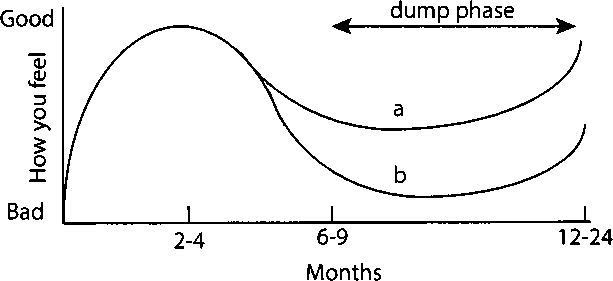
Figure
7.1. A chart with two different scenarios for the dump phase or “detox roller coaster ride. ’’Note that the curves and timescales are schematic and approximate.
* a is if you continue chelating and taking your supplements
* b is if you panic and start doing something else than chelating and taking your supplements
7.6 What does methylation have to do with mercury detoxification?
Methyl mercury, the kind found in fish, is fat soluble and very easy to absorb. Once it is in you, your body takes the methyl group off and transforms it into the more dangerous, water-soluble inorganic mercury. It gets past your cell membranes to start in its methylated form, but then it is demethylated and not fat-soluble anymore. It gets stuck in whichever cell or organ it wound up in.
Mercury vapor is another form of mercury that is extremely easy to absorb. It evaporates from mercury amalgam fillings and when you breathe it in, it shoots right through your cell membranes, and, just like the methyl mercury, turns into inorganic mercury which can’t come back out.
Inorganic mercury is the dangerous form of mercury that does all the damage. In mammals inorganic mercury cannot be remethylated and excreted. Mammals don’t have the enzyme that allows this to happen. No matter how many methylating supplements you take, you cannot remethylate that mercury. It is stuck inside you behind lipid barriers and it will never come out on its own.
You don’t have the right enzyme to methylate mercury. Fish do. They can remethylate mercury and move it out of their brain and other organs. This is why fish can have such high mercury levels and remain healthy. The fish stay healthy, but the people and other mammals that eat these fish become horribly toxic.
To sum things up: in mammals and birds, methylation has nothing to do with detoxifyng mercury. In fish, methylation keeps the mercury in them safe. Nothing you can do about methylation will help your detoxification pathways clear out mercury. You don’t have the right enzyme. You can’t remethylate mercury. Only fish can remethylate mercury.
7.7 Chelating lead
The conventional belief is that once you have lead poisoning nothing can be done. This is not true. Lead can be chelated out of your body
2 years or decades or even half a lifetime after you got it. The approach, however, is a bit different from chelating mercury.
The body stores lead in the bones. It needs to be chelated out of the blood so the bones will release their stored inventory. Getting rid of lead takes several years because you have to chelate the blood, wait for it to fill up again from the bones, and then chelate some more. No chelator will remove lead from the bones directly so there is no way to speed things up. The good news is DMSA works far better for lead than anything does for mercury, so you only have to chelate one weekend every month or two once you get past the early stages of the process. DMSA is easy to take orally, unlike EDTA, and poses no risk of making your mercury problem worse.
Basic supplements for lead are the same as those for mercury except that you don’t need the zinc and magnesium.
7.6.1 Protocol for chelating lead
1. Make very sure there is no current exposure before starting chelation for lead. This means educating yourself about all the places lead can be hiding, checking if there is any lead in your environment and getting it cleaned up. There should also be no current exposure to mercury as DMSA will chelate that, too.
If there may be an ongoing exposure, do not take molybdenum or vitamin D. Take 250 mg of calcium citrate, or a combination of calcium and magnesium, with each meal until you are certain there is no ongoing exposure.
2. Do eight rounds of DMSA as explained above in section 7.2.1.
3. After these initial eight rounds, do one round of DMSA every one to two months. Continue this for three to five years.
4. As with mercury it is difficult to know when you are done chelating. You have to go by symptoms because a hair test will show normal toxic element levels long before you are well.
5. You can chelate lead at the same time you are chelating mercury.
6. For sources of exposure to lead, see Hair Test Interpretation , pages 73-74. For symptoms, see pages 97-101.