Chapter 19
THE TRUTH ABOUT WITHDRAWAL
IN THIS CHAPTER
• No Pain, Huge Gain • Traumatic Tales From The Big Con • Rearranging The Furniture • Nothing To Wait For • With Easyway, Freedom Is The Reward
When smokers fear that quitting will be painful, they’re thinking about the withdrawal period, when they first stop taking the drug and any remaining traces of it drain out of their system. They’ve been brainwashed to believe that the physical effects of withdrawal are traumatic. The truth is very different.
NO PAIN, HUGE GAIN
I’ve described the withdrawal from nicotine as a mild, empty, slightly insecure feeling. I’ve also stated that the only reason a smoker lights up is to relieve that feeling, and that eventually that feeling causes a mental process during which the Big Monster creates the ‘I want a cigarette! I can’t have one! Aaargh!’ feeling.
Withdrawal is 1 per cent physical and 99 per cent mental
The physical sensation of withdrawal is so mild as to be almost imperceptible.
Smokers spend a lot of time planning to make sure they never find themselves in the dreaded situation of having no cigarettes. It’s a thought that can create panic long before their cigarettes run
out. How often have you been out at night and calculated that you’ll be awake for another four hours, but have enough cigarettes left to last for only an hour? The realization creates panic, which intensifies as you smoke the last cigarette in your pack. Even though you’re smoking and nicotine is flowing into your body, the panic feels like withdrawal pangs. That’s the Big Monster.
ALLEN CARR’S CASEBOOK: THE PANIC-FREE SMOKER
Most of the smokers who come to our seminars nod knowingly when I refer to ‘that panic feeling’ you get when you know your supply of cigarettes is running out. But there’s sometimes one who shows no recognition at all. ‘I’m sorry,’ they say, ‘I have no idea what you’re talking about.’ The rest of the group stare at him in surprise.
These looks turn to incredulity when I later remark that smokers will smoke camel dung rather than nothing, and the panic-free smoker says, ‘I can’t agree with you. If I couldn’t get my own brand, I wouldn’t smoke anything.’
Is he being honest? We know that all smokers have to lie to themselves, but when they come to one of our seminars we generally find that they welcome the chance to be honest and purge their conscience. So is the panic-free smoker the exception that proves the rule?
Not at all. The panic-free smoker is always a heavy smoker and the reason he doesn’t know the panic feeling is because he has always made sure to avoid it. The panic-free smoker is so frightened of suffering that panic feeling that he takes every precaution to make sure he never gets low on cigarettes.
And while he believes it must be his chosen brand or nothing, he has never risked having that belief tested. The panic-free smoker is neither lying nor telling the truth. He just hasn’t
discovered yet what it feels like to be denied cigarettes. Every smoker who is prevented from smoking feels that sense of panic.
I used to panic when I got down to my last few packs! I wasn’t happy playing a round of golf unless I had three full packs on me. I could smoke only 40 per round at a push, so why the need for three packs? It all stemmed from an occasion when I used to carry two and I dropped one pack in a puddle. The cigarettes were soaked and ruined. So I learned from my mistake and made sure I always carried three packs to cover every eventuality.
The panic of withdrawal is all in the mind. It’s the Big Monster that ties you in knots, makes you fidget and sends you racing to the corner shop late at night to make sure you’re well stocked up. There is no physical pain. The physical sensation that arouses the Big Monster is minuscule.
It’s uncertainty that causes the panic. Earlier in the book we looked at the example of students sitting an exam without being distracted at all by the craving for a cigarette. It’s the same situation when you board a plane. You have certainty. You know you’re not going to be allowed to smoke for the next few hours, so you stop worrying about it.
It’s when you want a cigarette and feel you should be doing something about it that the fidgets start and the panic sets in.
We have spent some valuable time helping you to rewire your brain, clearing your mind of illusions and myths, and replacing them with the certainty that smoking does nothing for you whatsoever and you will not miss it at all. When you achieve that certainty about your decision to quit, the minuscule physical feeling of withdrawal doesn’t induce fear and panic because you know exactly what’s causing it and that it will be gone within a matter of days
.
The feeling is the Little Monster dying and you don’t even have to wait until it’s dead to start enjoying life as a happy non-smoker. Whenever you feel that tiny sensation, rejoice in the knowledge that you’re killing your mortal enemy and making your escape to freedom.
I struggled to kick the habit – I would make a decision to give up smoking, but it was very very hard. I couldn’t resist the urge to steal a smoke whenever I had the opportunity. It was at that time that I was gifted Allen Carr’s book The Easy Way to Stop Smoking . After I read that book, I didn’t touch a cigarette again.
Mahesh Babu
TRAUMATIC TALES FROM THE BIG CON
You have probably heard accounts from smokers who have tried to quit and reported that they went through some terrible trauma. You may even have suffered that trauma yourself. A quick internet search throws up a pretty unappealing list of the symptoms of nicotine withdrawal:
headaches
coughing and sore throat
nausea and intestinal cramping
tingling hands and feet
sweating
weight gain
anxiety
irritability
insomni
a
difficulty concentrating
depression
Every one of these symptoms is a result of the mental panic that sets in when you try to quit with the willpower method. We’ve already discussed most of these symptoms, from weight gain down, and you should be clear that they are not caused by not smoking; they are caused by smoking. Depression, difficulty concentrating, insomnia, irritability, anxiety and weight gain are all psychological conditions. The first five symptoms are indeed physical, but they are the physical manifestation of the stress that you put yourself under when you try to quit with willpower.
People who quit with willpower are taking a leap in the dark. They don’t know what it takes to quit, let alone whether they have what it takes. They have no idea how long they’ll need to draw on their willpower before their craving goes. They don’t even know how they’ll know whether they’ve succeeded in quitting or not. All this uncertainty is created by the belief that they’re making a sacrifice. ‘How long can I cope with feeling deprived?’ No wonder they feel anxious as soon as they put out their final cigarette! They feel like they’re jumping off a burning building with a blindfold on and waiting for the worst not to happen.
It’s the stress and anxiety that cause the headaches, nausea, sweats and other unpleasant physical symptoms of withdrawal. Take away the stress and the physical symptoms go too. Be aware too that not every smoker who quits with the willpower method suffers these symptoms. Most find that the withdrawal period is actually much less severe than they expected.
You’re ahead of the pack: you already know that you have absolute certainty about what you’re doing. By the time you begin to feel any slight physical feeling, you already know you have no
need or desire to smoke another cigarette in your life. The fact is you probably won’t even notice any physical feelings, certainly nothing more alarming than spotting a piece of fluff, out of the corner of your eye, on your shoulder.
‘That’s all very well and good, but when I quit in the past it was torture! How is that not going to happen again?’
That’s a fair question and it’ll certainly help if you can understand what’s happened in the past when you tried to quit and failed.
Not only that, but I need to explain what an ‘ IWAC ’ moment is and how ‘habit’and ‘routine’ can cause trigger moments WITHOUT causing you problems when you’ve quit.
What smokers suffer when they use willpower to stop are not physical withdrawal pangs from nicotine but feelings of deprivation, frustration and irritation resulting from a particular mental process. I’m now going to illustrate that mental process.
Let’s see what happened to you in the past when you tried to stop smoking and failed because your brain became obsessed with cigarettes and you felt terrible because of what you thought was nicotine withdrawal.
It starts with our routine. Now please don’t misunderstand me. You don’t smoke because you’re in the routine or habit of doing it. Habits are easy to break. For example, if you take a morning shower, you might brush your teeth beforehand.
This would be a habit or routine that you will have repeated every day without even thinking about it for many years. If you wanted to change that habit and brush your teeth after your shower instead, would that be difficult? No, of course not.
You might find yourself reaching for the toothbrush before
heading for the shower for the first few days. If so, that would easily be rectified by putting a sign by the toothbrush to remind you to shower first. After a couple of weeks, it would then become second nature and you’d have to make a conscious effort to change back if you wanted to. So a habit or routine which has become so ingrained that you’ve been doing it automatically every day for many years without even thinking about it can be changed overnight without the slightest difficulty.
Our routine often triggers thoughts by association. Imagine that you tried to stop smoking in the past and your routine brought you back home from work in the evening.
You’re sitting around at home wondering what to do. This might have been a moment in the past when you would have lit a cigarette. It triggers a thought. ‘I want a cigarette!’
Let’s call that ‘ IWAC .’
The next thought you have is, ‘I CAN’T HAVE ONE.’ (‘ ICHO ’)
The next feeling you have is a combination of deprivation, frustration and irritation which I’m going to sum up by the word ‘ AAARGH! ’
I can’t explain it any better than ‘ AAARGH! ’ It’s a horrible feeling. Remember right now that the feeling wasn’t triggered by nicotine withdrawal – it’s the result of that ‘ IWAC ’ thought.
You now wind yourself up even more by telling yourself, ‘I can’t bear this, so I’ll try not to think about it.’ So you battle it and fight it and try not to think about it.
Then what happens? You think about it even more! It’s impossible to force yourself to ‘not think’ about something. If I say, ‘Whatever you do, don’t think about a banana now.’ What are you thinking about? Exactly – bananas. By trying not to think about it, your brain becomes obsessed with it, and that once again triggers the ‘IWAC’ thought. And the cycle of misery, torture and hell
speeds up. So again you think ‘I WANT A CIGARETTE’, followed by ‘I CAN’T HAVE ONE’, followed by that horrible ‘AAARGH!’ feeling… so you try not to think about it and therefore you think about it even more! The cycle repeats.
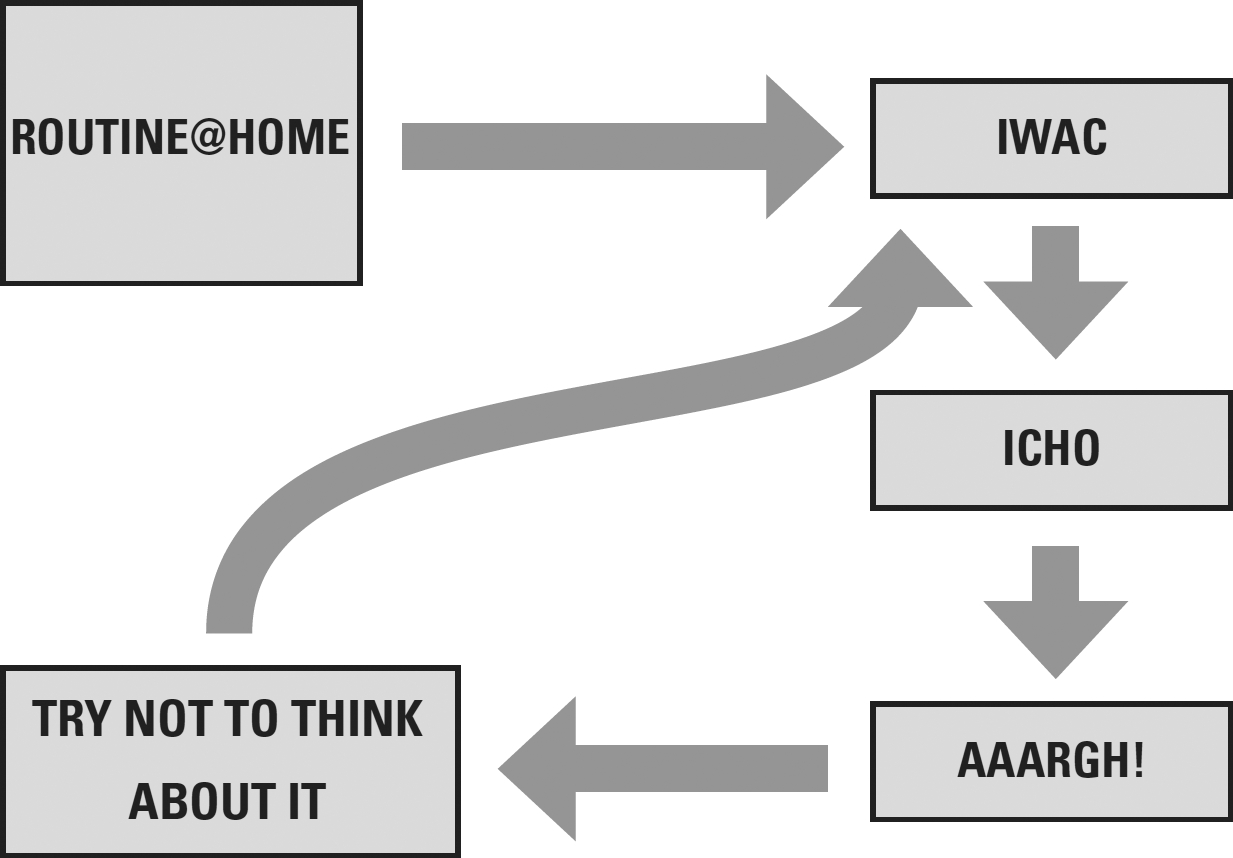
All you did was get home from work! This process is repeated at all the trigger moments you’ve battled with in the past when you tried to quit. After dinner, after leaving the Tube or getting off the bus, during a break from work, after making love. It can turn moments of real, genuine pleasure into moments of despair.
I’ll stress this again. Realize that the ‘Aaargh!’ feeling is nothing to do with nicotine withdrawal. It’s a feeling resulting from the mental process: ‘I WANT A CIGARETTE… I CAN’T HAVE ONE… AAARGH!’
Nicotine withdrawal was occurring during your Tube journey home from work, but it’s so slight you weren’t aware of it. As you step out of the Tube, you automatically light a cigarette. You’re responding to the very mild physical withdrawal, which, combined with routine or habit, triggers the ‘IWAC’ thought
.
It’s the mental process that makes the withdrawal period insufferable. Unless. You. Get. Your. Head. Right!
Allen Carr’s Easy Way to Quit Smoking effectively rewires your brain to disrupt those dysfunctional thought processes. It reboots your mind back to its natural state, before you became addicted to nicotine.
Rather than mistaking the physical reaction to a mental process for physical withdrawal from nicotine and having to battle it, you simply ‘reboot’ and correct your thinking and feel great.
Thinking ‘IWAC’ really isn’t a problem when you’re a happy non-smoker.
REARRANGING THE FURNITURE
Some people ask me how long before they won’t think ‘IWAC’ at all? That varies, but the truth is it really doesn’t matter as long as you are happy not smoking. Have you ever rearranged the furniture in a room at home? You’re delighted with the new layout and the way it looks. Later you walk back into the room and the new layout takes you a little by surprise. It takes a short, painless moment of adjustment to get used to the new layout. That might occur a few times over the first day or so, but very quickly the new layout becomes the complete norm.
The process certainly isn’t unpleasant. In fact, it just reminds us that the layout of the room is now exactly as we wanted it.
The essential thing for you to understand at this point is what that ‘I WANT A CIGARETTE’ thought means after you’ve finished this programme.
Some people think it’s obvious and say, ‘Well, if my brain thinks I WANT A CIGARETTE!, then it must mean I WANT A CIGARETTE!’
But that’s simply not true. At the height of an argument with a friend, your brain might momentarily think, ‘I could kill you now.
’
That thought doesn’t make you a murderer; it doesn’t even mean that you’re a bad person.
It’s just a thought. It isn’t the thought that’s important; it’s how you react to the thought that matters.
The human brain has tens of thousands of thoughts each day, so many that we can’t even process them all. Some of them are wild and whacky. Some of them are completely inappropriate. You might be a perfectly normal person, and you may well have had quite a few wild and whacky thoughts today already.
Let me give you an example. This is not a wild or whacky example; it’s just an example of how your brain gets it wrong sometimes and also illustrates how we deal with that error without anxiety, concern or self-doubt.
Imagine you have your own designated parking spot at work or at home, and you park your car there every day for a year.
Now imagine that your designated parking spot is moved, just one space along the row.
On the first day after the changeover would you be surprised if you parked your car in the old parking spot by mistake?
Of course not; it’s almost bound to happen.
Now imagine that you do exactly that. You drive into the old parking spot by accident.
Would you turn the engine off, throw your hands in the air and say, ‘My goodness, I’m SO infatuated with this parking space, I’m so emotionally attached to it, I can’t possibly move?’ Of course not!
What would you do? You’d simply move the car to the new parking spot. Would you start worrying that you have a car-parking problem? Of course not.
Does it mean that you desperately want to park in your old parking spot rather than the new one? Of course not.
So what does it mean
?
It just means that your brain forgot that your parking spot had moved. That’s all. And it’s not a big deal.
If the same thing happened again the next day, it wouldn’t bother you either. You would just repark your car. It wouldn’t take any willpower, and it doesn’t mean that you want to park in one spot rather than the other. It just means that your brain needs a little time to automatically log that your parking spot has moved. It’s very basic rewiring.
You’ve put a ton of metal in the wrong spot, and you just brush it off without any self-doubt or recrimination.
In fact, can you imagine the physical feeling you’d get as you realized that you’ve just pulled into the wrong spot? A slight tightness, a feeling in your gut. That’s exactly the same feeling as the ‘I WANT A CIGARETTE!’ feeling, but because you brush it off automatically it doesn’t fester and develop and grow into ‘ Aaargh ’.
If you understand how this could happen in the example of parking your car in the same spot, once a day, every day, for one year, think about how many times a day as a smoker or vaper, JUULer, dipper, chewer or snuser you might have to experience that IWAC, IWAV, IWAJ, IWAD, IWAS thought.
Exactly. Ten, 20, 50 or even more times a day, and it’s not something you’ve been thinking and reacting to for just a year, but for how many years? Five? Ten? Twenty? Thirty, or 40, or even more years?
Do you understand, just on principle, that after you complete this programme, the thought ‘ IWAC ’ doesn’t mean that you actually want a cigarette?
Of course it doesn’t. It just means that for a moment your brain has forgotten that you’ve quit – which after years of smoking isn’t surprising.
You don’t want to smoke or be addicted to nicotine anymore.
You definitely don’t want a cigarette or vape or JUUL or dip or chew or whatever. That’s exactly why you’re reading this book.
So, if that ‘ IWAC ’ thought pops into your mind once you’ve quit, and it momentarily triggers the ‘ Aaargh ’ feeling, don’t panic. Be cool, welcome it, rebalance yourself and think: ‘YIPPEE – I’m free.’
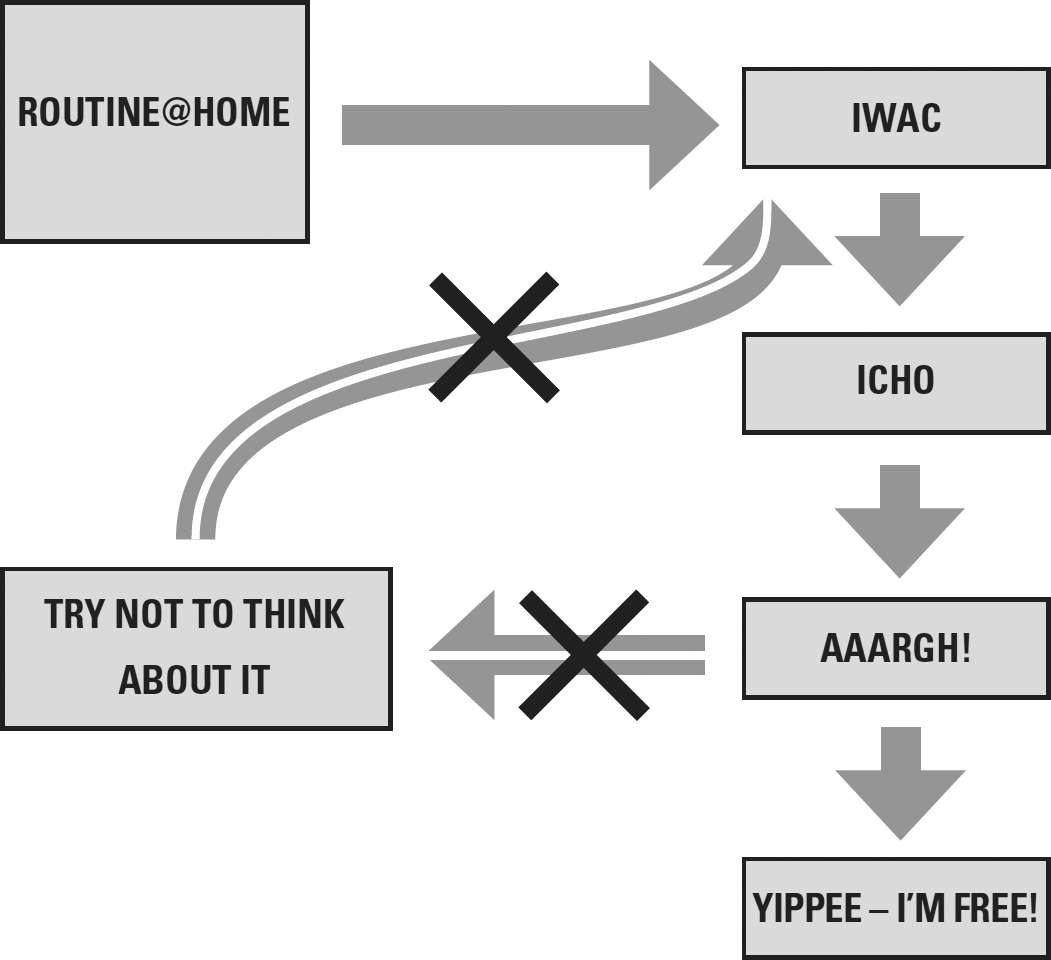
It’s only when you try not to think about it that it’s a problem. When you remind yourself of the parking spot analogy, you can’t stop smiling.
Rather than having moments of struggle or upset, which creates a horrible negative cycle, you’ll experience moments of pure joy.
If you can understand all I have just explained in principle, then your brain is halfway home to being rewired and rebooted.
Your reaction to ‘ Aaargh ’ won’t be to try not to think about it, therefore ensuring that you think about it even more. Instead, your reaction will be to reboot, correct and feel great.
When you lit your first cigarette, you created an evil Little Monster inside your body, a parasite that feeds on a powerful
poison called nicotine. As soon as you stop smoking and cut off the supply of nicotine, you have done the one thing required to purge yourself of that evil monster.
From this moment the Little Monster begins to die. In its death throes, it will try to entice you to feed it.
Create a picture in your mind of this vile little parasite writhing and squirming, and enjoy starving it to death.
Keep this image in mind and you will ensure that you don’t mistake the feeling for ‘I want a cigarette.’ Focusing on the feeling will help you to see it for what it really is. Be aware just how slight the feeling is – an empty, insecure feeling that makes you fidget a bit. Remind yourself that this feeling was caused by the last cigarette. It may not be a pleasant feeling, but it’s not intolerable either.
Far from it. You could easily live with it. After all, you lived with it every day when you were smoking.
The only difference now is that instead of responding to the feeling by lighting a cigarette, you are responding by doing nothing. As you brush away that piece of fluff you can say to yourself, ‘YIPPEE! – I’M FREE!’
The monster that would have happily destroyed you is now being destroyed by you. Very soon you will be free of any trace of the Little Monster. The only thing that can prevent that from happening is if you respond to its death throes by smoking a cigarette.
NOTHING TO WAIT FOR
Nicotine is a fast-acting drug; most of it leaves the body in a matter of hours. You might be aware of the final traces of it leaving your body for a few days.
For smokers who quit with willpower, the period after the Little Monster dies can be a dangerous time. Having started out
being obsessed with not being allowed to smoke, they suddenly realize that time has gone by and they haven’t thought about smoking.
This typically happens after about three weeks, or just over a couple of weeks after the end of the withdrawal period.
Everything the smoker hoped for appears to have come true. They have managed to go three weeks without smoking and it seems they’re not even missing it. Wow! It wasn’t that hard after all. This is cause for a small reward. And what possible harm could it do to reward themselves with just one cigarette?
If they’re foolish enough to light one, they’ll find it tastes unusual and gives them no illusion of pleasure.
Remember, the only reason any smoker thinks the cigarette gives them pleasure is because it partially relieves the symptoms of withdrawal from the previous cigarette. The nicotine from the previous cigarette in this case has long passed out of their system, so there is nothing to relieve.
The fact that the cigarette does nothing for them gives them extra confidence. But they’ve put nicotine back in their body and soon they will feel the withdrawal symptoms again. One little voice will be saying, ‘That tasted awful’, but another will be saying, ‘Maybe, but I’d like another one.’ They’ll exercise their self-control and resist having another one immediately. They don’t want to end up on the hook again, so they allow some time to pass.
They feel like they’re in complete control, but already their freedom is being undermined.
The next time they’re tempted, they can now tell themselves, ‘I smoked last time and didn’t get hooked, so what’s the harm in another?’
Ring any bells
?
Before long they’re right back in the trap, cursing themselves for their weakness and resigning themselves to a life of addiction.
The fact is, most people who use willpower to quit experience discomfort for months afterwards. They might have killed the Little Monster, but the Big Monster is what causes all the unpleasant symptoms. It is their response to a thought process, triggered no longer by nicotine withdrawal but by something reminding them that they used to smoke.
People who quit with the willpower method are always watching the clock, chalking off the days, feeling like they deserve a reward. With Easyway, there’s no sense of marking time and no need for a reward because you don’t feel like you’re depriving yourself of anything. In fact, you’re rewarding yourself from the moment you stub out your final cigarette.
Allen Carr’s Easy Way to Stop Smoking programme achieved for me a thing that I thought was not possible – to give up a 30-year smoking habit literally overnight. It was nothing short of a miracle.
Anjelica Huston
WITH EASYWAY, FREEDOM IS THE REWARD
So by the time the Little Monster dies, you will already be getting on with life as a happy non-smoker and you probably won’t even notice the withdrawal symptoms, let alone the fact that they’ve stopped.
The point is that there is absolutely nothing to fear from the withdrawal period after you quit. You don’t have to wait to get through it or behave any differently when it’s over. In fact
…
ENJOY IT!
THE JITTERS
Soon you will smoke your final cigarette or have your last shot of nicotine, ever. The thought of this moment and the freedom from nicotine addiction is incredibly exciting and the thrill can make you feel jittery, nervous and impatient. You might mistake these feelings for panic, but you can easily dispel any confusion by reminding yourself of everything you know and understand and asking yourself what possible reason there is to panic. Nothing bad can happen by stopping smoking. Only good can come of it.
Be aware of your reasons for feeling so excited. The tyrant of nicotine addiction has dogged you for too long and now you are about to be rid of it. You have unravelled all the brainwashing that kept you imprisoned and miserable and very soon you are going to complete the simple step to freedom.
From then on you will start to feel physically and mentally stronger. You will have more money, more energy, more confidence and more self-respect.
You stand on the brink of a magnificent achievement. Has it been hard getting to this point? You may have found it annoyingly repetitive, but I can assure you that this is quite intentional and entirely necessary. Have you found it painful? Or are you now convinced that it is possible to quit smoking easily, painlessly and permanently, without relying on willpower or using substitutes?
If the latter, you’re ready to prepare yourself for the ritual of…
The final cigarette
(or e-cigarette or dose of nicotine by any other means)