Chapter 2
the nicotine trap
IN THIS CHAPTER
• The Pitcher Plant • Security Of The Prison • The Tug-Of-War Of Fear • The Pleasure Of Smoking • The Big Monster • Your Objective • Escape Is Easy
We’ve established the real reason why you smoke – because you’re in a trap called nicotine addiction. Now we need to examine the trap you’re in, learn how it works and understand how you can escape.
THE PITCHER PLANT
The more subtle a trap is, the more effective it is at catching unsuspecting victims. The nicotine trap is so ingenious that not only do its victims not see it coming, they don’t even realize when they’ve been caught. It dawns on them only when they’re well and truly hooked and struggling to escape.
A good comparison is the pitcher plant, that carnivorous wonder of nature which feeds on flies. The pitcher plant is so-called because of its distinctive jug shape. The plant’s nectar attracts flies, which alight on the upper rim of the pitcher and start to feed. The fly has no fear of the plant. Why should it? It can fly off whenever it wants. But right now the nectar tastes good, so there’s no reason to think about flying away.
As the fly continues to feed, it ventures deeper into the pitcher. The sides are steeper here and slippery with sweet nectar. The fly loses its grip occasionally and turns back towards the light, but the nectar is too good to resist and the instinct to fly away is not
triggered until it’s too late. By the time the fly realizes that there’s something wrong about this plant, it’s lost its grip and fallen into the digestive juices at the bottom of the pitcher. Now it’s the plant devouring the fly, rather than the other way around.
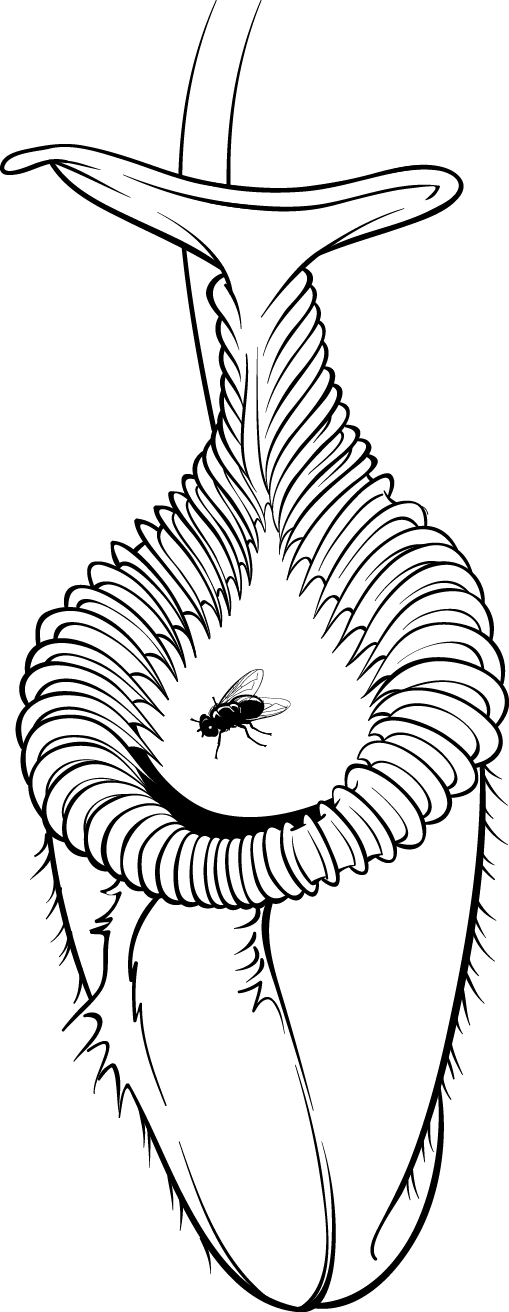
The pitcher plant
With the nicotine trap, there is no sweet nectar to lure victims in. The lure is purely psychological. We all light our first experimental cigarette for a variety of foolish reasons. From birth we’re brainwashed into believing that it might help us to fit in, to appear more grown up, to seem more sophisticated or to be rebellious. The list is endless. First-time smokers find the taste and smell revolting, yet they are still drawn into the trap because somewhere in their mind the seed has been sown that smoking is something that can give them pleasure. They’re not sure what that pleasure is – and those first puffs certainly don’t offer any insight – but they know enough people who do it to convince them that it’s worth the effort.
The revolting taste and smell of cigarettes is enough to prevent some first-time smokers from ever smoking a second time, and thus never getting hooked, but for others it contributes to the deadly lure of the trap.
It makes them think, ‘I could never get hooked on this’, and so they stumble on, confident they can stop any time they
choose. Like the fly, their confidence is actually dreadfully misplaced.
SECURITY OF THE PRISON
The nicotine trap is not just ingenious in the way it snares its victims. Even when they realize they’re hooked and desperately wish they could escape, the trap grips them tighter, making the idea of escape seem more daunting than the prospect of staying in the trap.
There is a similar psychological effect with long-term convicts when they’re finally released from prison. Rather than embracing their newfound freedom, a large proportion of them reoffend within a short period of their release. They don’t do it because they believe crime will pay and they’ll get away with it this time; they do it because they want to get caught and put back inside. They crave what they’ve come to consider the safety and security of the prison.
Prison may be tough, confining and miserable, but for the long-term convict it offers the comfort of familiarity. The world outside is daunting and full of questions: Can I fend for myself? How do things work? Will I cope with all the changes? Will anyone want to know me? For smokers, the nicotine trap offers the same feeling of ‘security’. This is what grips you and makes it hard to escape. You know that smoking is deadly, that it’s already damaging your health and wealth, yet the prospect of living life without cigarettes, suffering torture and hell in the attempt to get free, and the assumption that, even if you succeed in quitting, you’ll end up feeling miserable and deprived for the rest of your life prevents you from even trying to quit.
Rather than seeing the nicotine trap as a hellish prison that they want to escape from at the earliest possible opportunity, smokers feel they are trapped between a rock and a hard place
.
THE TUG-OF-WAR OF FEAR
The force that drives the long-term prisoner to reoffend so soon after being released is FEAR. Smokers block their minds to the devastating effects of smoking for the same reason. If they paid attention to what they know to be the truth about smoking, they would have to stop – and that frightens them even more. This explains why smokers spend their lives blocking their minds to the many powerful reasons to quit and search for any flimsy excuse to have ‘just one more’ cigarette.
Smokers are pulled apart by a constant tug-of-war that takes place in their mind. On one side, a voice is saying, ‘It’s killing me and costing me a fortune. It’s filthy, disgusting, and it’s controlling my whole life.’
On the other is a voice saying, ‘How can I enjoy life and cope with stress without my little pleasure or crutch? Quitting won’t be easy. Do I have the willpower to even try? And will I ever be able to say I’m completely free?’
There is one thing at both ends of this tug-of-war: FEAR. It is overwhelmingly fear that keeps smokers trapped. On the one hand, the fear of what will happen if we carry on smoking – on the other, the fear of what will happen if we stop; how will we cope?
Easyway will get rid of both of those fears. Don’t worry, I have no intention whatsoever of preaching to you about the downsides of smoking. You know all about those already. The biggest mistake that well-intentioned health campaigns make is to use fear to encourage smokers to stop.
As smokers we turn a blind eye to it anyway. The moment someone on the radio or TV starts talking about the damage caused by smoking, we simply switch channels. Even on those rare occasions when we allow ourselves to dwell on the downsides of smoking, in situations where we’re forced to do so, what’s the
first thing we do? We light a cigarette. A smoker’s reaction to any stressful situation is to light a cigarette. Attempting to cure a smoker by telling them about the damage it’s causing to them is not only an insult to their intelligence but a complete waste of time; it’s entirely counter-productive, like trying to extinguish a fire with a bucket of gasoline.
As soon as you’re a happy non-smoker, the fear of being a smoker disappears. It’s a fabulous feeling of freedom; one you can anticipate with relish. Getting rid of the fear at both ends of the tug-of-war, the worry about how you’ll cope without cigarettes, how you’ll handle stress, how you’ll manage to relax, control your weight, enjoy socializing and live everyday life without cigarettes is what this book will achieve.
THE PLEASURE OF SMOKING
As I demonstrated in the last exercise, most smoking is done without much thought. The only times you’re aware of it are when you’re coughing and wheezing and wishing you’d never started; or when you’re breathing smoke into the face of a non-smoker and feeling embarrassed and antisocial; or when you’re running out of cigarettes and beginning to panic; or when you’re in a situation where you’re not permitted to smoke and you’re feeling deprived.
So what sort of pleasure is that? A ‘pleasure’ that when you’re doing it, you’re either not aware that you’re doing it or you’re wishing you weren’t, and that seems precious only when you can’t do it! Yet smokers are terrified by the prospect of spending the rest of their lives without it.
THE BIG MONSTER
The lure of the nicotine trap is purely psychological. Nobody takes up smoking because they are drawn to the taste or smell.
It’s the belief that they are getting into something a bit naughty or pleasurable or beneficial, that lures them in.
It’s the same belief that keeps them trapped. The smoker’s tug-of-war of fear exists because of the belief that smoking gives them some sort of pleasure or crutch. Take away that belief and the arguments for smoking simply disappear. Smoking becomes exposed for what it really is: pointless. And if there is genuinely no point in doing something, why would it require any willpower not to do it? It doesn’t. You’ll be no more inclined to stick a cigarette in your mouth than you might be to stick it in your ear.
I’ve introduced you to the Little Monster, which feeds on the nicotine from each cigarette and complains as it leaves your system. When you smoke the next cigarette, the Little Monster is satisfied and you feel a sense of relief flooding back. But then it dissipates and the Little Monster starts moaning again. This is the cycle of addiction. Smokers believe that cigarettes relieve their stress and help them relax and concentrate. They don’t realize that it’s smoking which causes them to be in a constant state of feeling stressed, tense and unable to concentrate in the first place.
Kill the Little Monster and you end the addiction
All you have to do to kill the Little Monster is starve it of nicotine – it dies within a matter of days. That’s how long it takes for the physical traces of nicotine to leave your system; in fact, most of it leaves within 24 hours, and any withdrawal pangs are so slight you’ll barely be aware of them.
So why has it been so hard to quit until now
?
Millions of smokers have tried to quit using willpower alone or willpower combined with nicotine patches or gum or e-cigarettes. Yet they have found they still craved a cigarette weeks, months, even years after the Little Monster had died. They have applied all their willpower to resist the cravings, but it takes only one offer of a cigarette at a party, or in some stressful situation such as a road accident or hospital emergency, or something as simple as a bust-up with their partner, and the trapdoor opens up and they fall in once again.
The fact is, if quitting were as straightforward as stopping smoking and waiting for the Little Monster to die, everybody would do it without fail. But there is a second monster, as I’ve mentioned already, the Big Monster that lives in the mind, that keeps smokers craving cigarettes long after they’ve quit.
The Big Monster is your perception of smoking as a pleasure or crutch. It is created by all the brainwashing from the tobacco industry, the entertainment world, other role models and even anti-smoking campaigners, who persist in giving smokers advice that is almost guaranteed to keep them smoking, rather than helping them to quit. These well-meaning but ill-informed folk perpetuate the myth that smoking is a habit, a pleasure, a crutch; that smokers smoke because they choose to; that smokers enjoy smoking; and – the greatest myth of all – that smoking is hard to stop.
When the Little Monster starts craving nicotine, the minute physical feeling is enough to waken the Big Monster. Without the influence of the Big Monster, it would be easy to dismiss the cries of the Little Monster and carry on your life without smoking, but the Big Monster interprets that faint, empty feeling as ‘I want a cigarette’ and convinces you that the only way to relieve the craving is to smoke or vape
.
This is the ingenuity of the nicotine trap. Each cigarette causes the craving for the next. And the belief that smoking gives you pleasure or a crutch is reinforced by the feeling of relief as one cigarette, or e-cigarette, fills the emptiness left behind by the previous one.
I have a very addictive personality, and for someone like myself who has smoked since I was 15, I promise you, Allen Carr’s book changed my life. The guy who cleaned my pool was like ‘You should stop smoking’ and I was like ‘Shut up, Mark.’ He told me he quit smoking after 31 years by reading the book. I didn’t even really want to quit. I smoked a whole pack of cigarettes reading the book, as it tells you to do, and I’ve never smoked again. If I can do it, I know for a fact anybody can.
Kim Zolciak
YOUR OBJECTIVE
By now you should be beginning to see why it’s so important to prepare yourself mentally before we move on to the next stages of helping you to quit nicotine. Your mind is currently occupied by a Big Monster that keeps convincing you that the drug is the solution to all your insecurities and discomforts. You believe it because every time you smoke you feel a sense of relief and interpret this as pleasure. But the ‘pleasure’ is nothing more than the partial relief of the discomfort caused as you experience withdrawal from the previous cigarette. In other words,
The only pleasure from smoking or vaping is the partial relief of the discomfort caused by smoking or vapin
g
It’s like wearing tight shoes all day just for the relief of taking them off. Why subject yourself to the pain in the first place?
When a smoker begins to understand how the nicotine trap works, you can see a light click on in their eyes. It’s a revelation. Most smokers go through life not even aware that they’re in a trap. They think they smoke because they choose to (although they can’t understand why), or because it helps them to relax (even though it actually makes them more stressed) or helps them to concentrate (even though it’s a constant distraction).
Until the nicotine trap is explained, smokers and vapers are left with a headful of contradictions that pull them in opposite directions: the tug-of-war of fear. ‘I know it’s killing me’ versus ‘How can I go through life without it?’ The solution is easy:
Kill the Big Monster
In order to do that, we need to unravel all the brainwashing that gave birth to the Big Monster in the first place.
ESCAPE IS EASY
A smoker is like a fly in a pitcher plant, but there’s one crucial difference. By the time the fly realizes it’s in danger, the opportunity for escape has passed. The smoker, on the other hand, can escape at any time. The ingenuity of the nicotine trap is also its weakness. You have the power to escape any time you choose because…
You are your own jailer
Nobody is holding a gun to your head and forcing you to smoke. Addiction keeps you trapped. Once you’ve realized this simple fact, you can cure the addiction and walk free any time you want
.
Here’s a prediction. When you finish this book, you will be a happy non-smoker. You will have walked out of the nicotine trap and you will have found the process incredibly easy. Perhaps you find that hard to believe right now. That’s OK. You’re not going to be required to do anything hard. In fact, I’m going to make life as easy for you as possible by setting out some simple instructions. All you have to do is follow the instructions and you can’t fail to quit smoking easily, painlessly and permanently.
First instruction: follow all the instructions
A few hours reading this book is no time to spend on something as life-changing as quitting smoking, yet you may well be feeling impatient already. Perhaps you’re champing at the bit already, wanting to get on with it, or perhaps it’s the complete reverse – you’re thinking about bailing out on the idea because it all seems too good to be true.
If you’re in the former category, keep your discipline; don’t be tempted to skip ahead and miss out parts of the programme. If you’re in the latter group, understand one thing: nothing bad is going to happen while you read this book, or afterwards.
You’re either going to find it easy to stop or not. If you fail, you’ll be no worse off than you are now. You really have nothing to lose, so if for no reason other than curiosity, or even simply to prove me wrong, just carry on reading while you carry on smoking, and follow the instructions.
We need to make sure that all the brainwashing is unravelled and that the Big Monster is well and truly dead when you come to smoke your final cigarette or have your final dose of nicotine. We can achieve that only if you follow all the instructions. It’s like the combination to unlock a safe. I could give you all the numbers for
the combination, but if you left any out or didn’t put them in the right order, the safe would remain tight shut.