Chapter 3
The Myth
IN THIS CHAPTER
• We’ve All Been Brainwashed • The Delusion Of Enjoyment • Your Survival Toolkit • Who’s Giving The Orders? • Distinguishing Instinct From Intellect • Change Your Perception
You should now understand that the real reason you smoke is purely to satisfy the Little Monster you created when you smoked your first cigarette, and the only reason you believe that smoking will relieve your craving is because of the Big Monster in your mind that interprets the cries of the Little Monster as ‘I want a cigarette.’ The next step is to recognize that you have been brainwashed.
WE’VE ALL BEEN BRAINWASHED
Smokers and non-smokers are brainwashed into believing a myth. The brainwashing is relentless and all of us are exposed to it from the day we are born. It comes in many forms and from many sources and you rarely hear it challenged. The net result of all the brainwashing is the myth that smoking offers some sort of pleasure or crutch.
The brainwashing is so all-consuming that even non-smokers believe it. Most people who have never smoked or been inclined to smoke will believe there may be something relaxing or stress-relieving in smoking.
You can’t really blame them; their attitude is often one of incredulity: ‘There’s no way that smokers would suffer all
the dangers and disadvantages of smoking if they didn’t get something from it.’
Even smokers who appear to smoke for pure pleasure give away their true feelings. I’m talking about those people who smoke only a few cigarettes a day. The implication is that they are in control, choosing where and when they smoke, unlike chain-smokers who light up one cigarette after another.
But those casual smokers are caught in exactly the same trap and they know it. They love to tell you that they can go days without a cigarette if they have to. Now why would they do that if they thought smoking was a genuine pleasure or crutch?
A lot of people love exercising. You never hear them bragging about how long they can go without exercising. They’d exercise all the time if they could because they love it and it makes them feel good. For them, exercising is a genuine pleasure. Smokers are always fighting the urge to smoke. What kind of a pleasure is that?
As long as you continue to perceive smoking as a pleasure or crutch, you will always find it hard to quit. But as soon as you can see that any perception of pleasure or crutch is an illusion created by a combination of brainwashing and addiction, you will find it easy and enjoyable to quit.
THE DELUSION OF ENJOYMENT
We all know the pitfalls of smoking. The health risks are drummed into us from a young age along with all the brainwashing, but, rather than putting us off ever trying a cigarette, the negative publicity adds to the myth. The element of danger, the taboo, the rebellion… this is what attracts us to smoking that first cigarette. It has nothing to do with how the cigarette actually tastes or smells.
But ask a young person why they’ve started to smoke and they’ll tell you they enjoy it. That’s strange, because they don’t
look like they’re enjoying it as they cough and splutter and try not to retch if they accidentally take the smoke down into their lungs.
Ask them again after a few weeks, when they’re inhaling like an old-timer, and they’ll tell you they enjoy the taste and smell. They’re not making it up this time. They actually believe that they have acquired the taste for it. In reality, they’ve just got used to the vile taste, smell and effect on their lungs.
Just a few weeks later they’ll answer the same question by saying that smoking relaxes them, helps them concentrate and gives them confidence. In a very short time, their perception of smoking has evolved from something that tasted and smelled disgusting into something that tastes good, smells good and makes them perform more effectively. The myth is cemented in their mind and they’re proud to be seen as a smoker.
But it doesn’t stay this way. Ask them again after a few years and they’re more likely to answer defensively that it’s just a habit they got into. This answer betrays the shame and helplessness they feel. They know there’s nothing good about smoking now, nothing to be proud of. It’s become a major drain on their finances and they’re becoming aware of the impact on their health and relationships, yet they’ve also found themselves powerless to stop doing it. Whenever they summon the willpower to attempt to quit, they feel deprived and miserable and return to smoking.
If the fly could see it was in a trap when it climbed into the pitcher plant, it would fly away. You have that chance now. Take it!
The excuses for smoking may change, but the real reason never does. Despite reaching the stage where it’s obvious that smoking is giving you no pleasure or crutch, you keep smoking to try to end the empty, insecure feeling created by the first cigarette. But each cigarette does not end that feeling; it does the very opposite
.
Each cigarette or shot of nicotine rekindles the craving and ensures that you suffer it over and over for the rest of your life
The only way to stop the craving is to stop feeding the Little Monster. Very soon it will die and the physical discomfort will stop. There are two ways to kill the Little Monster: the hard way and Easyway. Kill the Big Monster first and quitting is easy.
YOUR SURVIVAL TOOLKIT
Think back to that first cigarette you ever smoked. All your instincts would have told you to avoid it, yet something in your mind made you persevere. If you had listened to your instincts, you would not be in this predicament now.
The human body is an incredible machine. Its powers of recovery are extraordinary. We abuse our bodies with all sorts of poisons – nicotine, alcohol, sugar, etc. – yet they keep soldiering on. Any time we decide to stop abusing ourselves and lead a healthier lifestyle, our bodies recover with extraordinary speed. It’s not just the body that feels healthier either. The mind responds to the way we live too. Eat healthily, take exercise, and we feel better mentally as well as physically. The reverse is also true: abuse your body and your mental health suffers too.
You have been equipped with a remarkable natural toolkit for survival. It consists of a number of reflexes, such as fear, pain and fatigue, which all serve to help keep you alive. Ironically, we tend to regard these things as weaknesses, but without them we would not last very long.
For example, we tend to equate fear with cowardice, but without fear we would wander blindly into deadly dangers, involving fire, heights and water. Fear is an instinct designed to
help us avoid danger. When threatened, our fear sends us into survival mode: fight, flight or freeze. Without it, our ancestors wouldn’t have survived.
Smokers often complain that they suffer with nerves and need cigarettes to calm them. Beside the fact that smoking will only make their nervous state worse, they’re overlooking the fact that nerves are part of the survival toolkit. If you jump out of your skin every time a door slams, that’s the same instinctive response as the one that sends the birds flying from the trees at the sound of a gunshot. When you’ve quit smoking, you will find your nerves are a lot less frayed.
Fatigue and pain are other instincts we try to fight off with caffeine drinks and painkillers. But we ignore the warning signs at our peril. Fatigue is your body’s way of telling you that you need rest. Pain is your body’s way of telling you it’s being attacked and you need to tackle the cause, not keep trying to suppress the symptoms with drugs.
By tackling the symptoms rather than the cause, as so much of modern medicine does, we don’t just allow the cause to continue, meaning the pain will get steadily worse; we also develop a tolerance against the drugs, meaning we need bigger and bigger doses to get the same effect. It’s the same downward spiral that occurs with any drug, including nicotine.
Your senses are a vital part of your survival toolkit and when you smoked that first-ever cigarette, your senses of taste and smell would have been screaming at you to stop. They would have detected poison and the strong revulsion you felt would have been their signals telling you: ‘DON’T TOUCH!’
We share these survival tools with the rest of the animal kingdom, yet while all other animals heed the warnings, we choose to override them. Why do you think that is
?
WHO’S GIVING THE ORDERS?
The tool that distinguishes human beings from the rest of the animal kingdom is intellect. It is another wonderful tool. Our intellect enables us to make judgments based not only on what is happening in the here and now but also on past experiences and even the experiences of others. It also helps us to predict future outcomes by using our imagination and projecting our experience on to hypothetical situations.
Thanks to this incredible tool, we have created sophisticated civilizations with remarkable architecture, art, literature, music, philosophy, sport and science. We no longer need to hunt for food, gather our own fuel for warmth or fight off predators. We have been able to share our intellect with future generations, ensuring the constant progression of technology and ideas.
But our intellect has also led us into disaster. Wars, weapons, drugs, slavery, prejudice and murder are all products of human intellect. But this hasn’t dampened our pride in our intellect, nor our faith in the power of human reason. So when our intellect and our instincts conflict, it’s our intellect from which we take orders.
The problem begins at birth, when the shock of coming into the world leaves us clinging to our mothers for security. In childhood, our parents comfort us with fairy tales and other kinds of make-believe: the Tooth Fairy, the Easter Bunny, Father Christmas…
Then comes the day when we discover that none of this fantasy world exists. Over time, our view of our parents changes. It begins to dawn on us that they are not the towers of strength we thought they were; they’re fallible, and they have weaknesses and fears just like we do.
The disillusionment leaves a void, an empty, insecure feeling, which we instinctively want to fill. We begin to let other people into our lives to fill the void, and with them come other influences.
We look to people who appear to have the confidence we crave: pop stars, film stars, sports stars, TV celebrities, models. These people become our role models and we copy their behaviour in the hope that it will lead us to be more like them – or the way we perceive them, anyway. If they dye their hair, we dye our hair. If they go to clubs, we go to clubs. If they drink, we drink. If they smoke, we smoke.
Instead of becoming complete, strong, secure and unique individuals in our own right, we become impressionable fans, leaving ourselves wide open to suggestion. But we don’t want our insecurities to show; we want to look self-assured, confident, in control, grown-up. So we begin to mimic the mannerisms of other apparently confident individuals. We think they look cool when they smoke and drink and we know smoking and drinking are ‘grown-up’ things to do because that’s what the law suggests and that’s what we’ve always been told. So we see smoking as a fast track to adulthood. Everything we have ever been told, including the warnings, leaves us in no doubt that smoking is a rite of passage.
The desire for security is instinctive. The belief that smoking provides security is intellectual. It’s a myth that has been put in your mind by a lifetime of brainwashing. As humans, our incredible ability to communicate and absorb information is matched by our ability to communicate and absorb misinformation.
When you come to smoke that first cigarette, your instincts do everything in their power to stop you. Your senses of taste and smell scream: ‘POISON! DON’T TOUCH!’
If you persist, other reflexes kick in. You cough and splutter as your body tries to eject the poison. Carry on regardless, and another sophisticated process goes into action: you build a tolerance to the poison, so your senses no longer react so violently against the
taste and smell. What smokers believe to be an acquired taste is, in fact, an acquired lack of taste, as you knock out your natural warning system.
You put yourself through this trauma because you believe the prize will be worth it. You’ve been brainwashed into believing that cool confidence awaits you. By the time you think you’ve acquired the taste, you’re already well and truly hooked and the cycle of addiction is drawing you deeper and deeper into the trap. All that awaits you is the miserable life of a smoker.
DISTINGUISHING INSTINCT FROM INTELLECT
If you trusted your instincts over your intellect, you would never have smoked that first cigarette. Like so many people, you didn’t trust your instincts, but it’s never too late to learn.
As I pointed out earlier, most cigarettes are smoked without the smoker paying any attention to them whatsoever. You might say that this is an instinctive reflex, but it is not a natural instinct designed as part of your survival toolkit. It’s a reflex created by brainwashing. If we do something enough times, the brain is rewired.
So how do we distinguish our natural survival instincts from our unnatural reaction to being brainwashed? It’s actually a case of distinguishing fact from fiction.
The brainwashing creates the belief in your mind that smoking offers some kind of pleasure or crutch. The cycle of addiction, whereby each cigarette offers partial relief from the craving created by the one before, convinces you that you do get some pleasure or comfort when you smoke. Remember, this is no more of a pleasure than the relief of taking off tight shoes.
But, you might ask, if you believe you’re gaining some pleasure from smoking, what does it matter if that perception is based on fact or fiction
?
Would you remain grateful to the thief for giving you £10 of the £100 he secretly stole from you once you found out about his ruse? Of course not.
It matters because smoking does the complete opposite of what you believe.
Smoking makes all smokers miserable. But you only realize just how miserable you have been when you stop
If the delusion really made you happy, you might argue that it’s worth all the money and the risks to your health. But it doesn’t. Smoking makes you irritable, self-despising and frightened. And the more you smoke, the worse you feel.
When you satisfy a genuine instinct like hunger or thirst, it gives you genuine pleasure and a lasting feeling of satisfaction and wellbeing. When you smoke, all you get is temporary and partial relief, which is quickly replaced by insecurity and emptiness. This void is created by the very thing that you take to relieve it. But you keep taking it because you believe in the myth. The only effective way to remove this artificial void is to remove the addiction.
Unravelling the brainwashing so that you can distinguish genuine instinctive fact from brainwashed intellectual fiction is actually incredibly easy. All you need to do is channel your intellect in the right direction and use it to replace misinformed responses with correctly informed ones.
Exercise: SEEING IS BELIEVING

This is a simple exercise to demonstrate how easy it is to reprogramme your brain through the correct application of intellect. Look at the image above, relax your mind and see what you can make of it.
At first glance it looks like a jumble of random black shapes. Now move the book gradually away from your eyes and try to focus on the grey space between the shapes. Can you see it yet? If not, half-close your eyes.
You should see the word STOP. Now bring the book closer again and you should still be able to see the word. It’s as clear as day, isn’t it? So why is it not apparent at first glance?
Your intellect has learned that the relevant text in a book is printed black on white, so you instinctively look for the formation of the black shapes first. All you have to do is reprogramme your intellect to look at the grey shapes, not the black, and you can quickly see the message.
What’s more, once you’ve seen the STOP message it’s impossible to look at the diagram again and not see it. Your brain knows for a fact that the word is there and you cannot fool your brain into believing that it’s not. The same happens when you see through the myth and recognize the truth about smoking – that it does absolutely nothing for you whatsoever. Once you’ve seen the truth, you can’t fool your brain into believing the myth again.
CHANGE YOUR PERCEPTION
To help you see through the myth, it helps to look at your addiction through the eyes of a non-smoker. You can get an idea of how that might seem by thinking about how you regard a heroin addict.
Apart from the tiny proportion of smokers who are also addicted to heroin, smokers have no problem in seeing that heroin will do absolutely nothing for them and that they neither need nor want it. You don’t have to keep convincing yourself.
So why do you think heroin addicts have this great desire to inject themselves with the drug? Do you envy them? Or do you thank your lucky stars that you’re not going through the same hell as them? If you could help them, wouldn’t you tell them to stop? Why do you think they can’t see their predicament in the same way as you? Could it be because their perspective has been distorted by the drug?
Now consider this: non-smokers regard you and your predicament in exactly the same way. It’s clear to them there is no pleasure and that smoking leaves you feeling more insecure, agitated and distracted than ever. Their perception is not distorted by any drug. They can see the facts as clearly as you just saw the word STOP.
If you’re still clinging to the myth that smoking offers you some sort of pleasure or crutch, it’s time to change your perception. You should already be seeing your addiction in a slightly new light. It’s not enough, though, just to understand the logic in what I’ve told you so far.
You have to accept it
That means questioning everything you believe to be true about smoking, including what I’ve told you, and examining it carefully until you see the truth, just as you did with the STOP diagram. This leads us to the second instruction.
Second instruction: open your min
d
Perhaps you think you are an open-minded person. But the mind can be easily fooled into believing something which is untrue. Once we believe in something we tend to close our minds to anything that contradicts it. The nicotine trap relies on this aspect of the human intellect. Only when you question your belief with an open mind can you determine fact from fiction.
Exercise: A CLASSIC ILLUSION
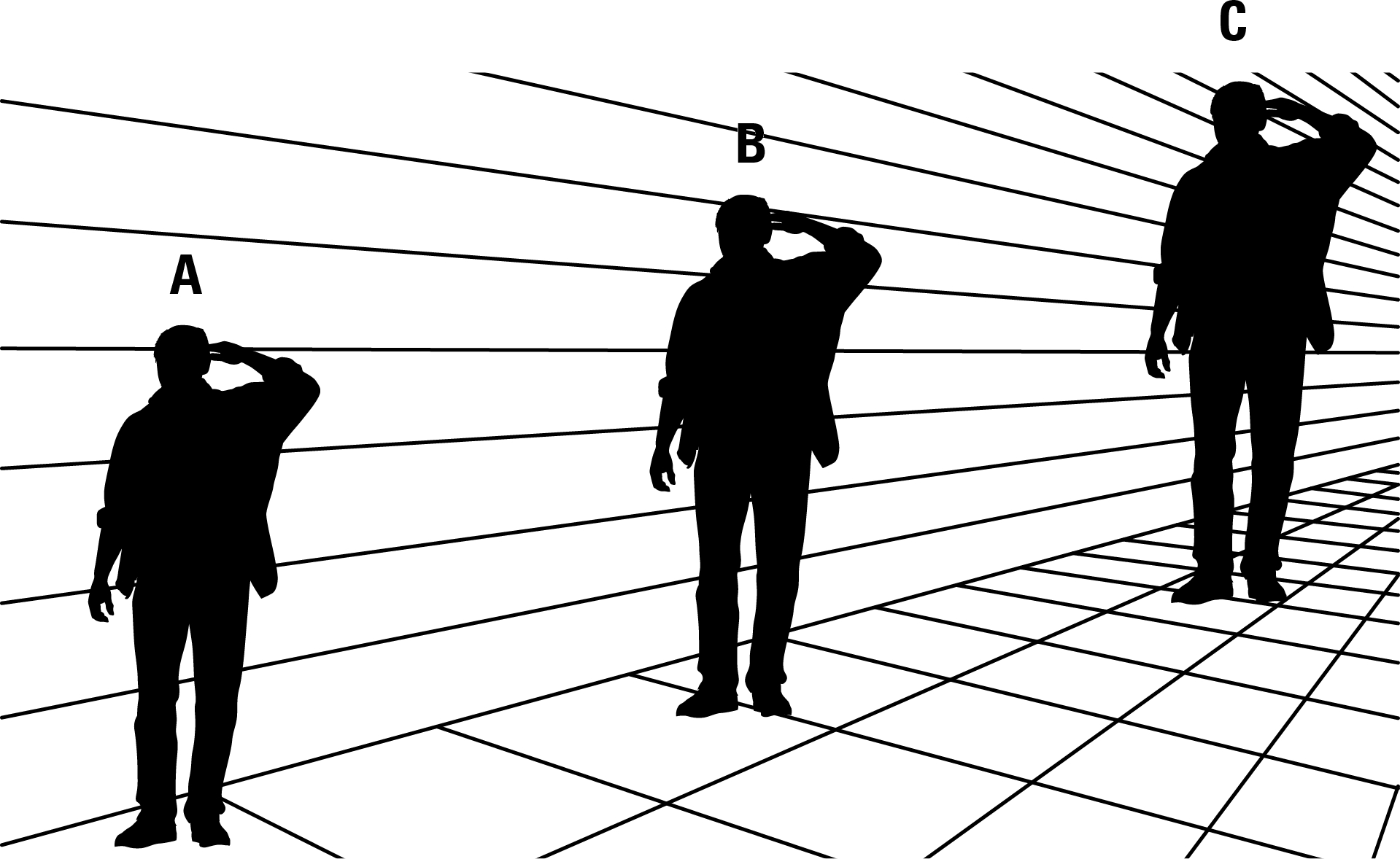
Illusions can be fun, as long as they’re not responsible for keeping you in a trap. Take a look at these three men. Make a note of who is bigger – A, B or C.
Now take a ruler and measure each one. Surprising, isn’t it?
What you’re looking at is a famous optical illusion. The image appears to give the figures different dimensions when, in fact, they are identical. Had you not been told to measure them, you would have continued to assume that they are different sizes.
Our brains can easily be fooled by illusions, but likewise illusions can easily be exposed. You just need to be willing to question what you think you know.